
 简体中文
简体中文
 English
 Français
 日本語
日本語
 Deutsch
0086-574-88881358
0086-574-88473625

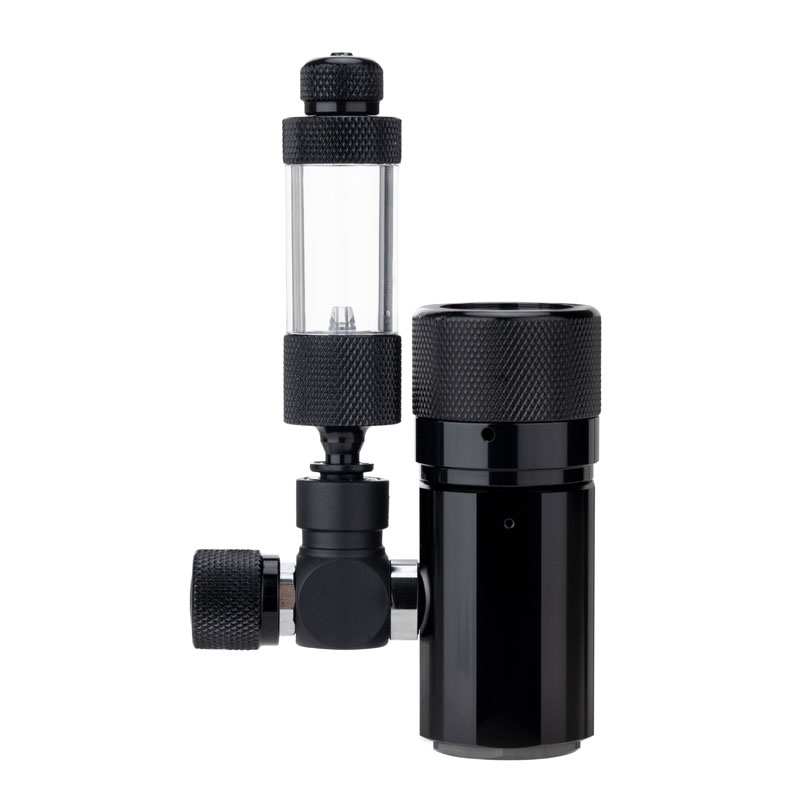
RP14-Aquarium Pressure Regulator
A compact CO2 regulator for small aquariums, with a pressure regulator, needle valve, and bubble counter. It has a 5/8-18UNF inlet for 74g cartridges. Optional EU, US, or Japanese adapters are available.
Equipped with an internal pressure gauge.
Non-leaking cylinder puncture ensures user safety when tightening the cylinder and achieves maximum gas utilization.
Bubble output error is within ±2 bubbles per minute.
360° rotatable outflow interface allows free adjustment of the outflow direction.
| Material | ▲ | Aluminum |
| Medium | CO2 | |
| Operating Temperature | -5℃~43℃ | |
| Max. Working Pressure | 12Mpa | |
| Proof Pressure | 30Mpa | |
| Output Pressure | ▲ | 0.40Mpa |
| Output Pressure Accuracy | ±0.03MPa | |
| Pressure Indication | ▲ | Push-in type pressure gauge |
| Indication Accuracy | Class IV (EN 837-1) | |
| Inlet Port | ▲ | 5/8-18UNF |
| Inlet adapter | ▲ | W21.8-14 / W22-14 / CGA320 / G5/8 / G3/4 |
| Outlet Port | ▲ | G1/8 |
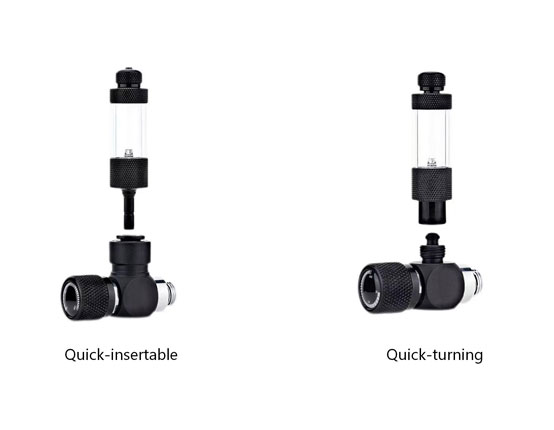
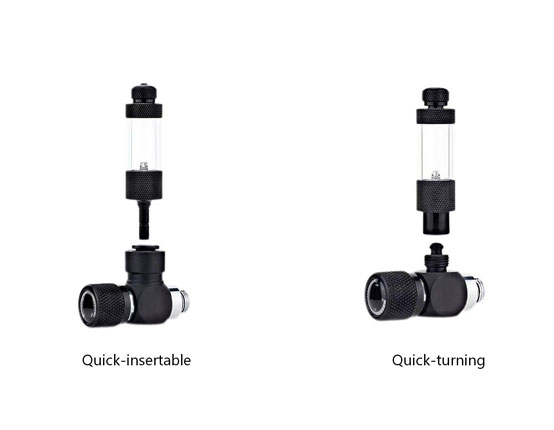
| Bubble Counter | Quick-insertable/Quick-turning | |
| Relief Pressure(LP side) | Overflow orifice relief mechanism | |
| Net Weight | 274g | |
| (▲ marked parts are standard parameters available for customization.) | ||
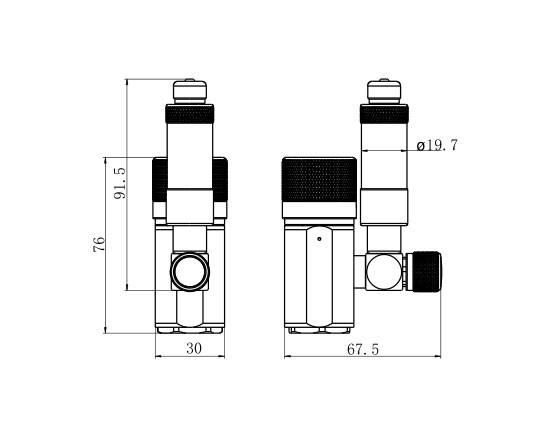
| Material | ▲ | Aluminum | |||
| Medium | CO2 | ||||
| Operating Temperature | ‑5℃~43℃ | ||||
| Max.Working Pressure | 12Mpa | ||||
| Proof Pressure | 30Mpa | ||||
| Output Pressure | ▲ | 0.4Mpa | |||
| Output Pressure Accuracy | ±0.02MPa | ||||
| Pressure Indication | ▲ | Push-in type pressure gauge | |||
| Indication Accuracy | Class IV (EN 837-1) | ||||
| Inlet Port | ▲ | 5/8-18UNF | |||
| Inlet Adapter | ▲ | W21.8-14 / W22-14 / CGA320 / G5/8 / G3/4 | |||
| Outlet Port | ▲ | G1/8 | |||
| Power Plug | CN/US/EU/UK/JP/KR/AU | ||||
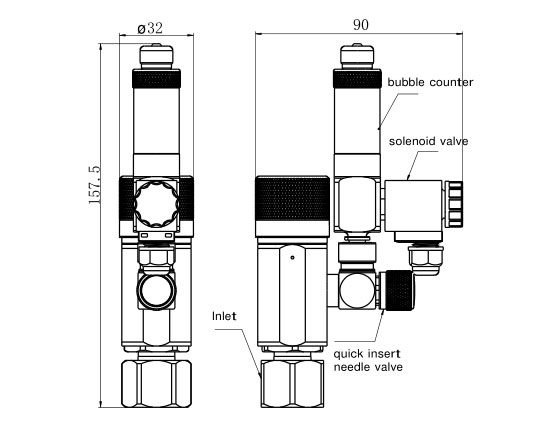
| Bubble Counter | Quick-insertable/Quick-turning | ||||
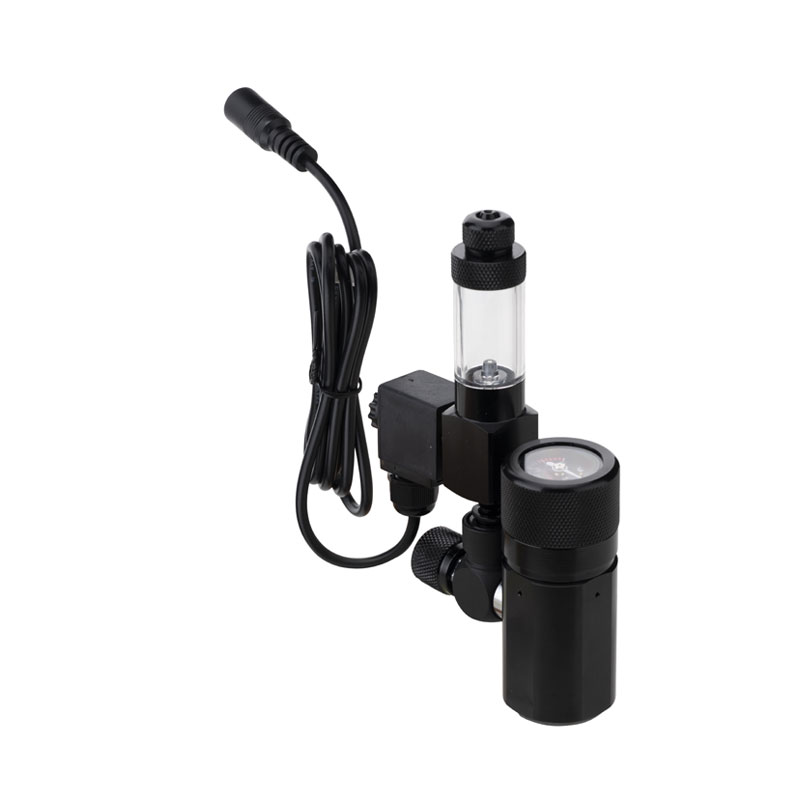
| Solenoid Valve | DC12V 3W,DC connector,IP65,Power Plug | ||||
| Net Weight | 330g | ||||
| (▲ marked parts are standard parameters available for customization.) | |||||
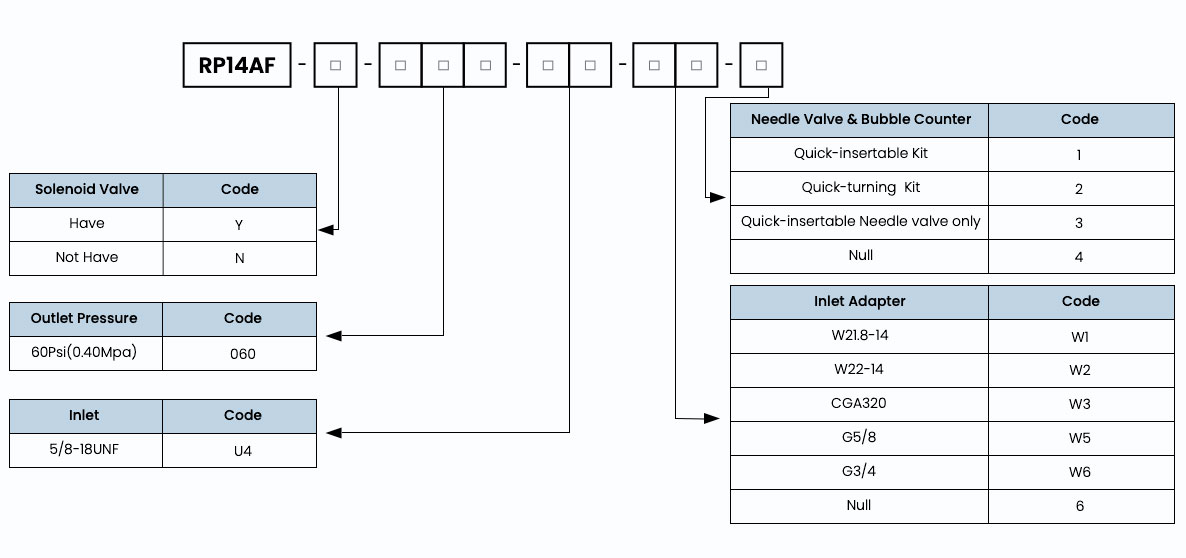
* Ordering code = Model + "-" + Solenoid Valve + "-"+Outlet Pressure+"-"+Inlet+"-" +Inlet Adapter+"-"+ Needle Valve & Bubble Counter
Example: RP14AF-Y-060-U4-W1-1
Contact Us to Place Your Order
Get quotations, request custom configurations, or receive technical support
Contact Us Now
Behind every healthy planted or reef aquarium sits a small but critical piece of hardware: the Aquarium Pressure Regulator. This device sits between a gas cylinder — typically CO2 for planted tanks or, in some setups, compressed air — and the delivery line running into the tank, and its job is to take a high, unstable cylinder pressure and turn it into a low, steady working pressure that a needle valve or solenoid can meter precisely. The category spans single-stage and dual-stage designs, bubble-counter integrated units, and models built for anything from a 10-gallon nano tank to a full fish room manifold. Getting this component right affects plant growth consistency, livestock safety, and how often a hobbyist has to babysit their equipment.
At Ningbo Noursun Industrial Co., Ltd, before a single physical prototype is machined, every regulator body goes through a digital finite element simulation cycle. Structural strength analysis and fluid dynamics modeling are run in a virtual environment using CAE/CAD/CAM tools, so diaphragm flex, seat wear points, and flow turbulence inside the chamber can be identified and corrected long before tooling is cut. This matters for an Aquarium Pressure Regulator specifically because the failure mode hobbyists actually notice isn't a burst fitting — it's slow output creep, where a regulator set to 15 PSI drifts upward as the cylinder empties, over-dosing CO2 overnight and stressing fish.
The chart below illustrates the practical difference between a single-stage design and a dual-stage design as cylinder pressure falls from full to near-empty over a typical tank's usage cycle.
Aquarium equipment lives in a humid, sometimes splash-exposed environment for years without a break, so brass body corrosion, seal swelling, and gauge fogging are ongoing concerns for manufacturers of any Aquarium Pressure Regulator. Quality control here is not a one-time test; it runs through an ISO9001-certified system and advanced in-house testing labs, and product lines carry certifications such as UL, NSF, CE, FDA, and EU depending on the target market — a detail our team at Noursun treats as a baseline rather than a selling point, since it simply reflects the standard the components are built to.
| Material | Corrosion Resistance | Typical Use |
|---|---|---|
| Nickel-plated brass | Good | Entry to mid-range CO2 regulators |
| Chrome-plated brass | Very good | Fish rooms, humid grow spaces |
| Stainless steel components | Excellent | Commercial/saltwater-adjacent setups |
A regulator that works well on a 20-gallon planted nano can behave very differently once connected to a 100-gallon+ system running a longer line and a finer needle valve. Larger volumes generally call for slightly more stable low-pressure output and a needle valve capable of fine adjustment at low flow rates, since a small dosing error matters more in absolute terms as tank volume grows. An Aquarium Pressure Regulator paired correctly with tank size reduces the number of times a keeper needs to readjust bubble count per second across a week.
Most regulator complaints trace back to three things: a worn diaphragm, a seat that has taken a slow set from years of pressure, or a gauge that was never checked against a known reference. A simple habit worth building is logging working pressure once a month rather than only when something looks wrong — a 2-3 PSI drift caught early is a five-minute adjustment; caught late, after a bubble-counter has been silently over-dosing for weeks, it becomes a livestock stress event. Noursun designs around safety, stability, simplicity, and aesthetics as core priorities, which in practice shows up as diaphragms and seats chosen to hold calibration longer between adjustments rather than needing frequent attention.
Monthly checks are a reasonable default for most planted or reef setups; systems running 24/7 dosing or older diaphragms benefit from checking every two to three weeks instead.
Not necessarily — output stability at the pressure the tank actually needs matters more than a high maximum rating that's rarely used in a home aquarium context.
Yes, with a manifold splitting the low-pressure output line, though each branch typically needs its own needle valve so tanks can be dosed independently. An Aquarium Pressure Regulator rated for higher flow is generally preferred as the source unit in these setups.
This is usually working pressure drift, ambient temperature change affecting gas density, or a slow leak downstream — checking the gauge is the fastest way to rule the first cause in or out.
ADD: No. 50, Zhongxing East Road, Xikou Town, Fenghua District, Ningbo City, Zhejiang Province, P.R. China
0086-574-88881358
0086-574-88473625
About Us
Industry Applications
News & Events
