
 简体中文
简体中文
 English
 Français
 日本語
日本語
 Deutsch
0086-574-88881358
0086-574-88473625

RP23-Aquarium CO2 Regulator
A compact CO2 regulator for aquariums with needle valve, and bubble counter. Fits 74g cartridges via 5/8-18UNF inlet thread.
Embedded axial pressure gauge.
Ensures easy and gas-tight cartridge piercing.
Multiple inlet adapters for different market requirements.
Independently developed for accurate and convenient outflow control.
Bubble output error is within ±2 bubbles per minute.
Allows free adjustment of outflow direction.
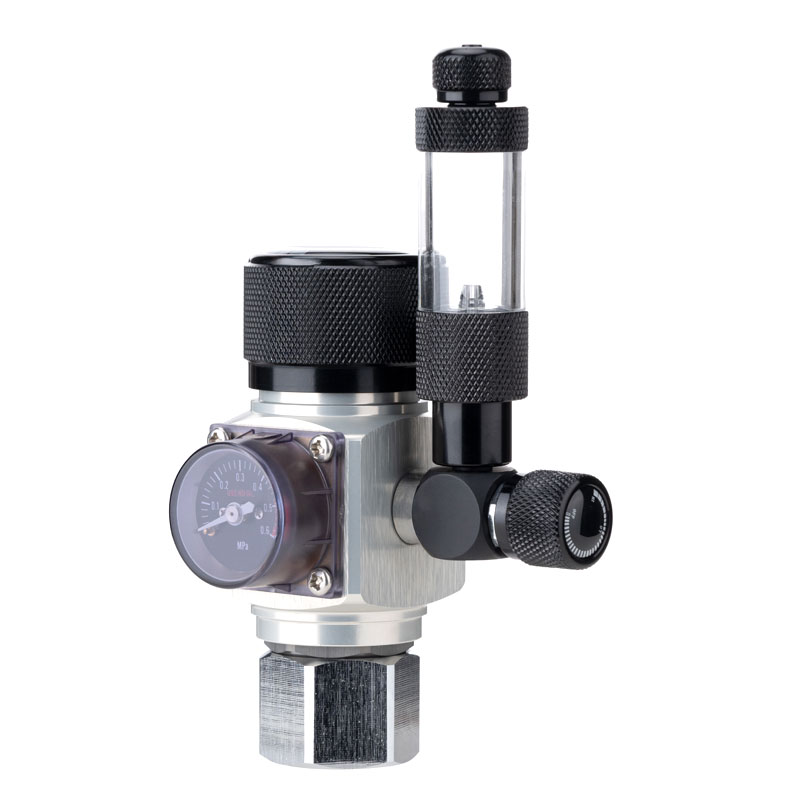
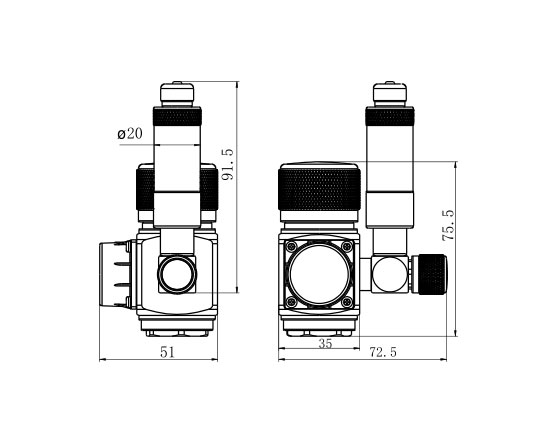
| Material | ▲ | Aluminum |
| Medium | CO2 | |
| Operating Temperature | ‑5℃~43℃ | |
| Max. Working Pressure | 12Mpa | |
| Proof Pressure | 30Mpa | |
| Output Pressure | ▲ | 0.20~1.00Mpa |
| Output Pressure Accuracy | ±0.03MPa | |
| Pressure Indication | Push-in Type Pressure Gauge | |
| Indication Accuracy | Class IV (EN 837-1) | |
| Inlet Port | ▲ | 5/8-18UNF |
| Inlet Adapter | ▲ | W21.8-14 / W22-14 / CGA320 / G5/8 / G3/4 |
| Outlet Port | ▲ | G1/8 |
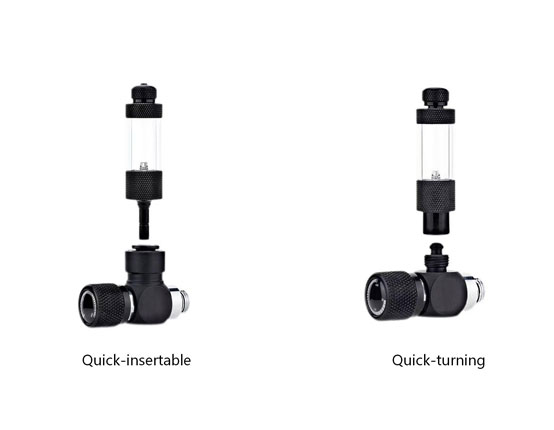
| Bubble Counter | Quick-insertable/Quick-turning | |
| (▲ marked parts are standard parameters available for customization.) | ||
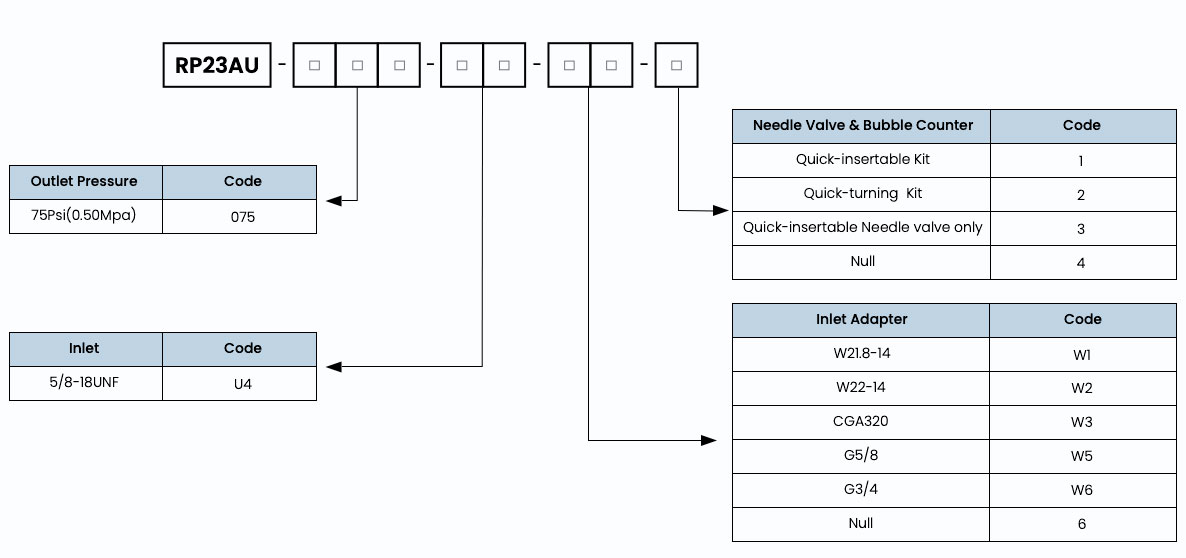
* Ordering code = Model + "-" + Outlet Pressure+"-"+Inlet+"-" +Inlet Adapter+"-"+ Needle Valve & Bubble Counter
Example: RP23AU-075-U4-W1-1
Contact Us to Place Your Order
Get quotations, request custom configurations, or receive technical support
Contact Us Now
A dependable Aquarium CO2 Regulator is the quiet piece of hardware that keeps a planted tank's carbon dioxide supply steady, second by second, day after day. Its job sounds simple — step high cylinder pressure down to a low, stable working pressure — but the way it does that determines whether your plants get an even, predictable feed of CO2 or a jittery one that swings with cylinder pressure and room temperature. This piece looks at what actually happens inside a regulator, why the same nominal specs can behave very differently in practice, and what to weigh when comparing the best co2 regulator for aquarium use across dual-stage and single-stage designs, solenoid control, and needle-valve fine adjustment.
Most confusion around CO2 regulators comes down to one design choice: single-stage versus dual-stage pressure reduction. A single-stage regulator drops cylinder pressure to working pressure in one step, which means the output pressure drifts as the cylinder empties — a well-known effect sometimes called end-of-tank dump. A dual-stage regulator splits the job into two steps, so the second stage sees a much narrower pressure window and holds output far steadier. In our own engineering work at Ningbo Noursun Industrial Co., Ltd, this staging behavior is one of the first things we model before a regulator body ever reaches prototype, because it directly decides how much a customer's downstream needle valve setting will drift over a cylinder's life.
The chart below illustrates the general pattern rather than one specific product's test data: as a cylinder empties from full toward near-empty, a single-stage design typically shows a widening deviation in output pressure, while a dual-stage design stays close to its original setting almost to the end.
This is why an Aquarium CO2 Regulator built as a true dual-stage unit tends to reward the extra cost over the life of a cylinder, especially for tanks where even small pH swings stress fish or shrimp.
The solenoid is what lets you tie CO2 injection to a timer or a controller, shutting gas flow off overnight when plants stop consuming it and oxygen matters more to livestock. A slow or sticky solenoid response is one of the more common causes of inconsistent bubble counts reported by hobbyists.
Fine adjustment happens here, and it is the component most sensitive to manufacturing tolerance — a needle valve machined loosely will not hold a one-bubble-per-second setting for long. This is a manufacturing question as much as a design one; on our own production line, this is where digital process monitoring at Ningbo Noursun Industrial Co., Ltd is applied most heavily, since even small variation in seat geometry shows up as drift at the tank.
The high-pressure gauge tells you how much gas remains in the cylinder; the low-pressure gauge tells you what the regulator is actually delivering downstream. A bubble counter, whether built in or added inline, is the practical way to translate that pressure into a real injection rate you can count and repeat.
Comparing dual-stage against single-stage designs across the qualities that matter most in daily use makes the trade-off easier to see:
Situated in Ningbo, China, Noursun is a high-tech enterprise investing about 7% of annual revenue in R&D, holding over 35 patents and filing roughly 10 new applications each year. That investment shows up less in marketing copy and more in the consistency of parts that most buyers never see — the machining tolerance on a needle valve seat, the repeatability of a diaphragm across a production run, the calibration of a gauge before it ships.
Using advanced manufacturing equipment, the company delivers customized pressure control solutions with high precision and consistency, and its digital management transformation is aimed squarely at production efficiency and on-time delivery as it advances toward smart manufacturing. The full project cycle, from conceptual design to mass production delivery, follows the internationally recognized Advanced Product Quality Planning (APQP) framework, which keeps quality, cost, and schedule under control from the very first drawing rather than catching problems after tooling is already cut.
For a component category where a fraction of a millimeter of tolerance decides whether a bubble count stays steady for months or drifts within weeks, that kind of process discipline is arguably more relevant to buyers than any single spec on a datasheet.
Choosing among the best co2 regulator for aquarium options usually starts with matching the regulator's fine-adjustment range to tank volume, since a needle valve that is perfect for a 20-gallon tank can feel twitchy on a 100-gallon system where a wider flow range is needed.
| Tank Size | Typical Bubble Rate | Needle Valve Sensitivity Needed |
|---|---|---|
| Under 20 gallons | 1 bubble / 2-3 sec | Very fine |
| 20-55 gallons | 1 bubble / sec | Fine |
| 55-100 gallons | 2-3 bubbles / sec | Moderate |
| Over 100 gallons | 3+ bubbles / sec | Wider range acceptable |
Once a rate is set, the main threats to consistency are mechanical rather than chemical: a slightly worn diaphragm, debris lodged in the needle valve seat, or a loose fitting slowly leaking. The chart below breaks down where drift most often originates in the field, as a general pattern rather than a formal study.
A quick monthly check of the diaphragm seal and needle valve, paired with keeping the drop checker in view, catches most of this before it affects plant growth. At Ningbo Noursun Industrial Co., Ltd, this is also the feedback loop that shapes design revisions — field-reported wear patterns feed directly back into which tolerances get tightened on the next production batch.
Do I need a dual-stage regulator for a small planted tank? Not strictly, but a dual-stage unit will hold its bubble rate more consistently as the cylinder empties, which matters most for sensitive livestock like shrimp.
Why does my bubble count change even though I haven't touched the needle valve? The most common causes are a nearly empty cylinder (single-stage designs are more affected), a temperature shift in the room, or early wear in the needle valve seat.
How often should I check the regulator for leaks? A soapy-water check on fittings once a month is a simple habit that catches slow leaks before they become noticeable pH swings.
Can one regulator handle both a small and a large tank if I move it later? Yes, provided the needle valve's adjustment range covers the lower flow rates a small tank needs — this is worth checking before assuming a larger-tank regulator will scale down cleanly.
ADD: No. 50, Zhongxing East Road, Xikou Town, Fenghua District, Ningbo City, Zhejiang Province, P.R. China
0086-574-88881358
0086-574-88473625
About Us
Industry Applications
News & Events
