
 简体中文
简体中文
 English
 Français
 日本語
日本語
 Deutsch
0086-574-88881358
0086-574-88473625

RP25-Aquarium Pressure Regulator
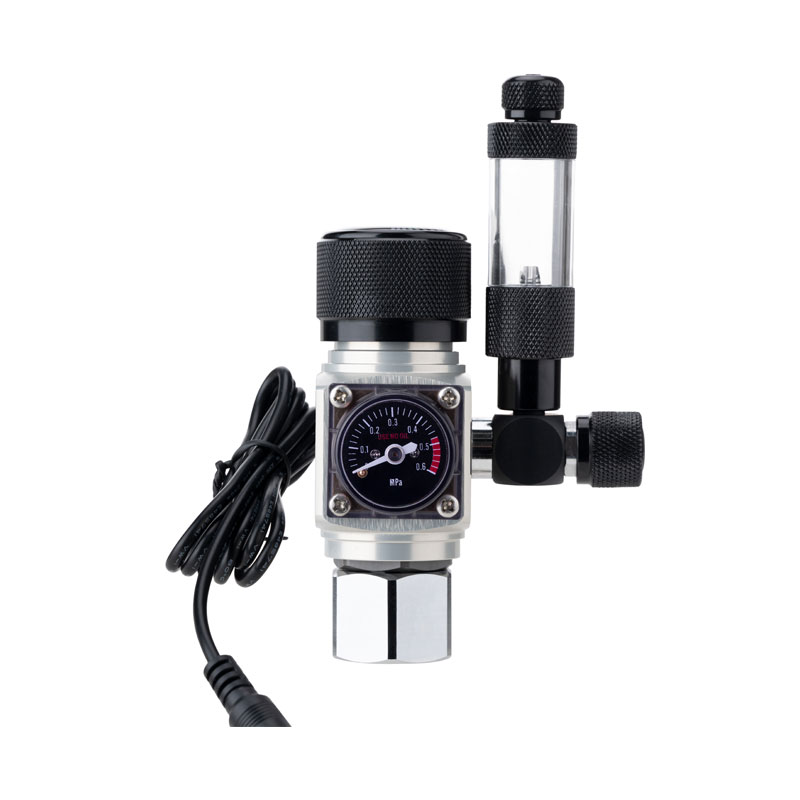
Compact CO2 regulator for small aquariums with needle valve, bubble counter, and solenoid valve. Fits 74g cartridges (5/8-18UNF); optional EU/US/JP adapters. Also suitable for mosquito and rat traps.
Embedded axial pressure gauge.
5/8-18UNF thread, compatible with 74g cartridges,Multiple inlet adapters.
Leak-proof piercing technology for easy and gas-tight cartridge piercing.
Allows free adjustment of exhaust direction.
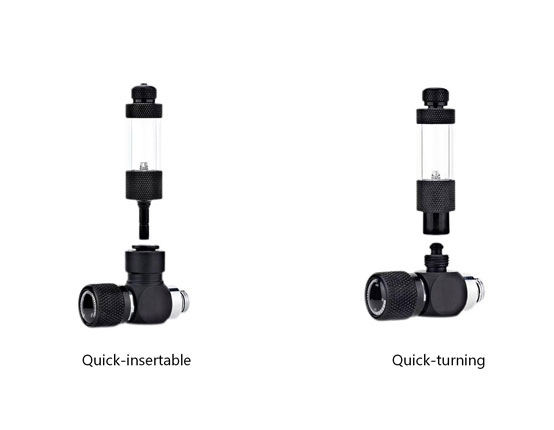
Quick-insert or quick-turn type for multiple counting choices.
| Material | ▲ | Aluminum | |||
| Medium | CO2 | ||||
| Operating Temperature | -5℃~43℃ | ||||
| Max. Working Pressure | 12Mpa | ||||
| Proof Pressure | 30Mpa | ||||
| Output Pressure | ▲ | 0-0.5Mpa | |||
| Output Pressure Accuracy | ±0.03MPa | ||||
| Pressure Indication | ▲ | Push-in type pressure gauge | |||
| Indication Accuracy | Class IV (EN 837-1) | ||||
| Inlet Port | ▲ | 5/8-18UNF | |||
| Inlet Adapter | ▲ | W21.8-14 / W22-14 / CGA320 / G5/8 / G3/4 / G1/2-14 | |||
| Outlet Port | ▲ | G1/8 / 1/8NPT | |||
| Power Plug | CN/US/EU/UK/JP/KR/AU | ||||
| Bubble Counter | Quick-insertable/Quick-turning | ||||
| Solenoid Valve | DC12V 3W,DC connector, IP65, Power Plug | ||||
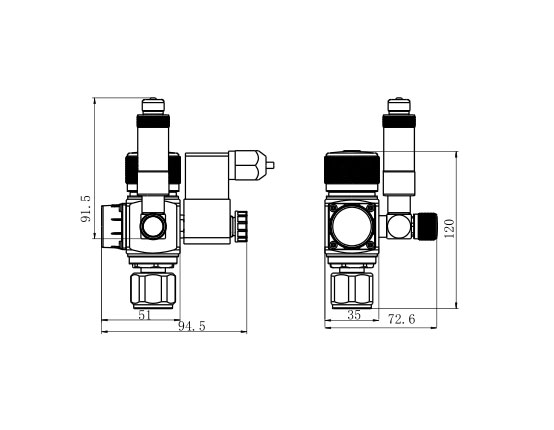
| Net Weight | 390g | ||||
| (▲ marked parts are standard parameters available for customization.) | |||||
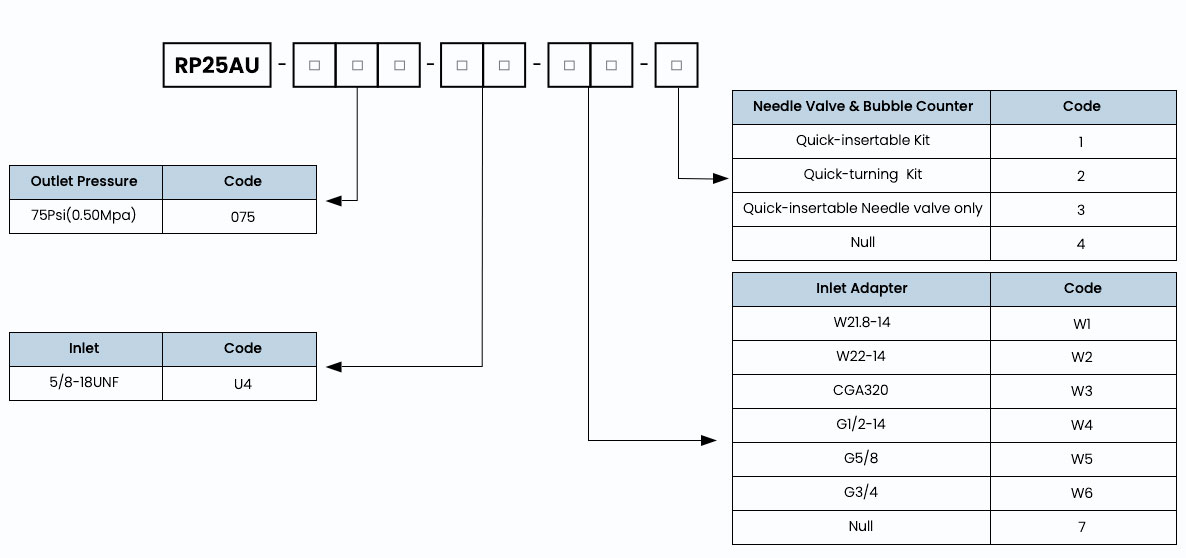
* Ordering code = Model + "-" + Outlet Pressure+"-"+Inlet+"-" +Inlet Adapter+"-"+ Needle Valve & Bubble Counter
Example: RP25AU-075-U4-W1-1
Contact Us to Place Your Order
Get quotations, request custom configurations, or receive technical support
Contact Us Now
Planted aquarium keepers rely on a steady, precisely controlled flow of pressurized gas to keep CO2 injection consistent from the first bubble of the day to the last. A device such as the RP25-Aquarium Pressure Regulator sits at the center of that control loop, stepping down a high-pressure cylinder charge into a stable, adjustable working pressure that feeds bubble counters, diffusers, and solenoid-timed injection lines. Rather than walking through a single product's spec sheet, this piece looks at the practical engineering questions behind aquarium-grade pressure regulation — output stability, correct sizing, mechanical durability, and the troubleshooting habits that keep a planted tank's CO2 curve flat instead of jumpy.
At Ningbo Noursun Industrial Co., Ltd, gas pressure control components and solutions are the entire focus of our engineering work, and one lesson repeats across every regulator category we build: a high maximum pressure rating tells a buyer very little about how a device behaves in daily use. What actually determines whether a planted tank's CO2 bubble rate stays flat across a full cylinder discharge cycle is how tightly the output pressure holds as inlet pressure falls from a full cylinder to a near-empty one. Designs built around this principle, including the RP25-Aquarium Pressure Regulator, aim to keep the delivered pressure inside a narrow band rather than letting it drift with the cylinder's own falling pressure.
The practical effect shows up as bubble-rate creep: an unregulated or poorly regulated line will speed up as the cylinder empties, pushing CO2 concentration past the point where fish show stress before a keeper notices the gauge has moved at all.
Sizing a regulator's output to a specific tank is less about the regulator's rated flow ceiling and more about matching a stable, low bubble rate to the tank's biological load. A heavily planted 200-liter tank with strong lighting consumes CO2 far faster than a lightly planted tank of the same size, so the working pressure window that feels correct for one setup can visibly overshoot in another.
| Tank Volume | Plant Density | Typical Bubble Rate |
|---|---|---|
| Under 60 L | Light to moderate | 1 bubble / 2–3 sec |
| 60–150 L | Moderate to heavy | 1 bubble / sec |
| Over 150 L | Heavy, high-tech | 2–3 bubbles / sec |
Refining that working-pressure window across so many tank profiles is exactly the kind of problem Ningbo Noursun Industrial Co., Ltd keeps working on, driving digitalization, intelligentization, and environmental sustainability into how gas pressure control components are designed and produced, with the broader goal of becoming a leading manufacturer of refrigerant gas pressure control components and solutions.
A regulator that performs well on day one but drifts, sticks, or leaks after a year of daily on/off cycling isn't solving the problem an aquarium keeper actually has. To keep that from happening, Ningbo Noursun Industrial Co., Ltd has built out an in-house testing laboratory that puts pressure regulators through durability, environmental adaptability, mechanical strength, and safety-limit assessments designed to simulate real-world operating conditions rather than a single idealized bench test.
This data feeds directly back into product refinement, and the goal is straightforward: extend service life, raise the practical safety margin, and make output performance more predictable over years of use rather than months, which is the kind of result the RP25-Aquarium Pressure Regulator is engineered around.
Most CO2 delivery problems in planted tanks trace back to a handful of recurring causes, and recognizing the pattern early usually saves a keeper from a much bigger correction later.
Keeping a simple log of gauge readings and bubble rate over the first month after installing a unit like the RP25-Aquarium Pressure Regulator makes it far easier to tell a genuine drift from normal day-to-day variation.
A quick check every one to two weeks against a drop checker catches slow drift long before it affects fish or plants, especially during the first few cylinder cycles after installation.
This is typically output drift as the cylinder empties. A regulator designed to hold a flat output curve across the full discharge range keeps this effect to a minimum, which is why output stability matters more than the maximum pressure a unit is rated for.
It can, provided each line has its own needle valve so individual tanks can be fine-tuned separately, since splitting a single fixed output across tanks with different plant loads usually leads to one tank being over- or under-dosed.
Yes, to a small but measurable degree — gas pressure naturally shifts with temperature, which is one reason environmental adaptability is part of how a regulator's long-term performance gets evaluated during development.
ADD: No. 50, Zhongxing East Road, Xikou Town, Fenghua District, Ningbo City, Zhejiang Province, P.R. China
0086-574-88881358
0086-574-88473625
About Us
Industry Applications
News & Events
