
 简体中文
简体中文
 English
 Français
 日本語
日本語
 Deutsch
0086-574-88881358
0086-574-88473625

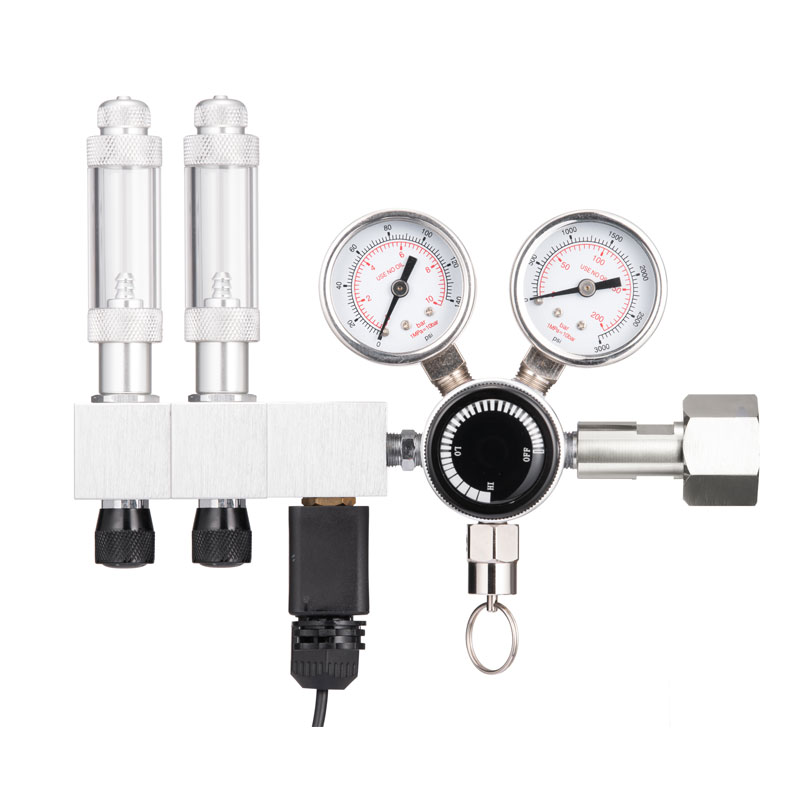
RP31-Dual Gauge Pressure Regulator
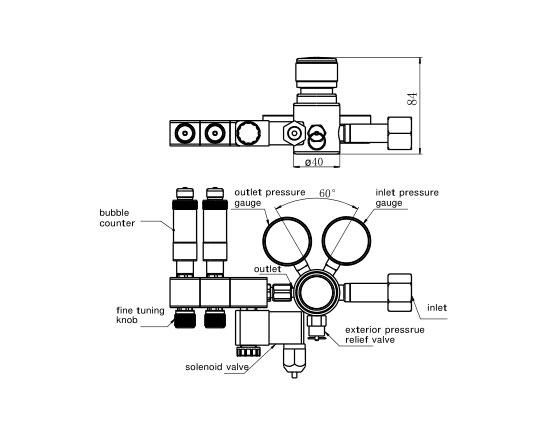
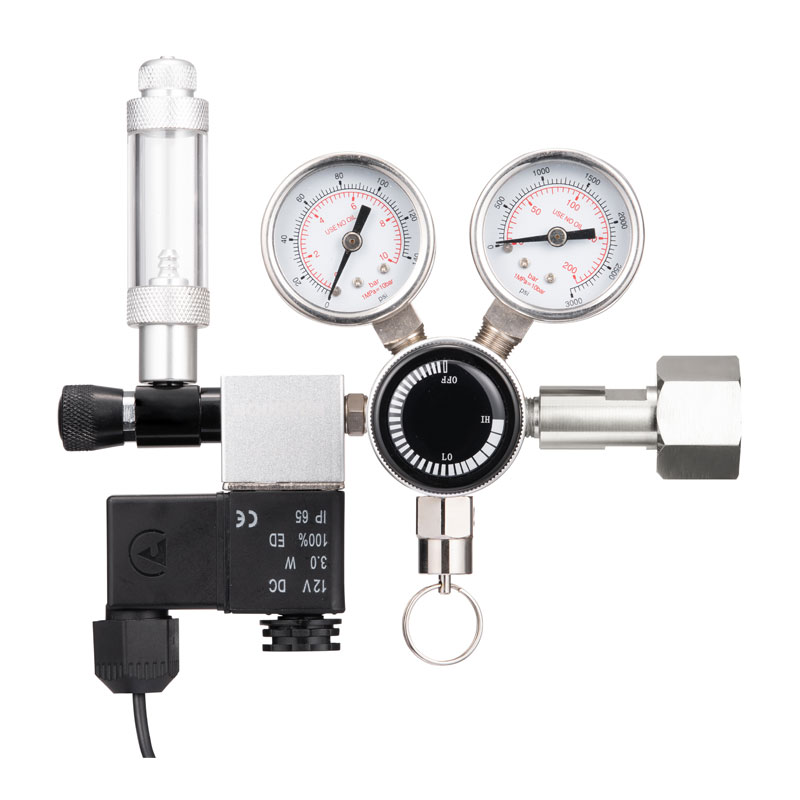
Designed for the aquarium market, featuring an external pressure relief valve, solenoid valve, needle valve, and bubble counter. Compatible with US, EU, JP, and CN CO2 cylinder inlets.
Integrated a pull-ring safety valve.
Dual gauges – For clear pressure monitoring.
High bubble accuracy – Error of less than ±2 bubbles per minute.
| Material | ▲ | Aluminum | |||
| Medium | CO2 | ||||
| Operating Temperature | ‑5℃~43℃ | ||||
| Max. Working Pressure | 12Mpa | ||||
| Proof Pressure | 30Mpa | ||||
| Output Pressure | ▲ | 0.30~0.60Mpa | |||
| Output Pressure Accuracy | ±0.02MPa | ||||
| Pressure Indication | ▲ | Y40 dual pressure gauges for inlet and outlet | |||
| Indication Accuracy | Class Ⅳ (EN 837-1) | ||||
| Inlet Port | ▲ | W21.8-14 / W22-14 / CGA320 / G5/8 / G3/4 | |||
| Outlet Port | ▲ | G1/8 / NPT1/8 | |||
| Relief Pressure(LP side) | 0.8Mpa | ||||
| Solenoid Valve | DC12V 3W,DC connector,IP65,Power Plug | ||||
| Power Plug | CN/US/EU/UK/JP/KR/AU | ||||
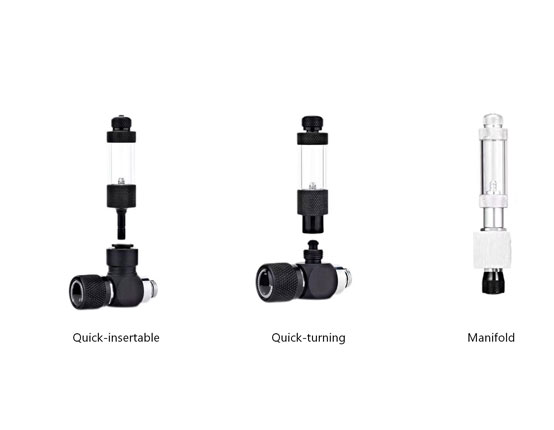
| Bubble Counter | Quick-insertable/Quick-turning | ||||
| Net Weight | 802g | ||||
| (▲ marked parts are standard parameters available for customization.) | |||||
| Material | ▲ | Aluminum | |||
| Medium | CO2 | ||||
| Operating Temperature | ‑5℃~43℃ | ||||
| Max. Working Pressure | 12Mpa | ||||
| Proof Pressure | 30Mpa | ||||
| Output Pressure | ▲ | 0.30~0.60Mpa | |||
| Output Pressure Accuracy | ±0.02MPa | ||||
| Pressure Indication | ▲ | Y40 dual pressure gauges for inlet and outlet | |||
| Indication Accuracy | Class Ⅳ (EN 837-1) | ||||
| Inlet Port | ▲ | W21.8-14 / W22-14 / CGA320 / G5/8 / G3/4 | |||
| Outlet Port | ▲ | G1/8 / NPT1/8 | |||
| Relief Pressure(LP side) | 0.8Mpa | ||||
| Solenoid Valve | DC12V 3W,DC connector,IP65,Power Plug | ||||
| Power Plug | CN/US/EU/UK/JP/KR/AU | ||||
| Bubble Counter | Quick-insertable/Quick-turning | ||||
| Net Weight | 697g | ||||
| (▲ marked parts are standard parameters available for customization.) | |||||
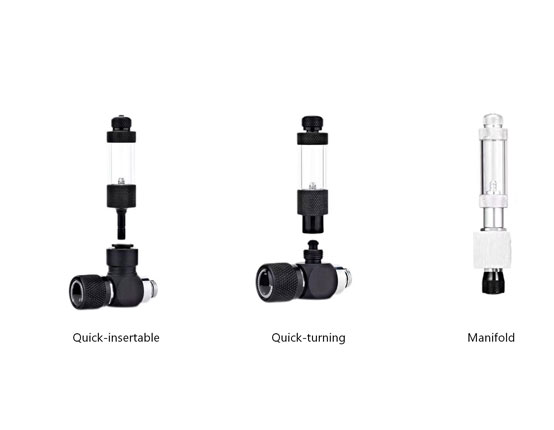
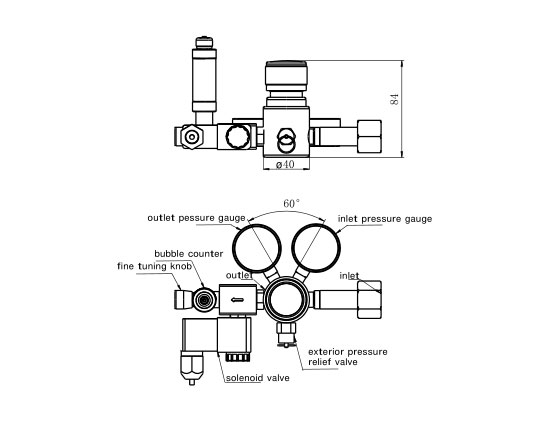
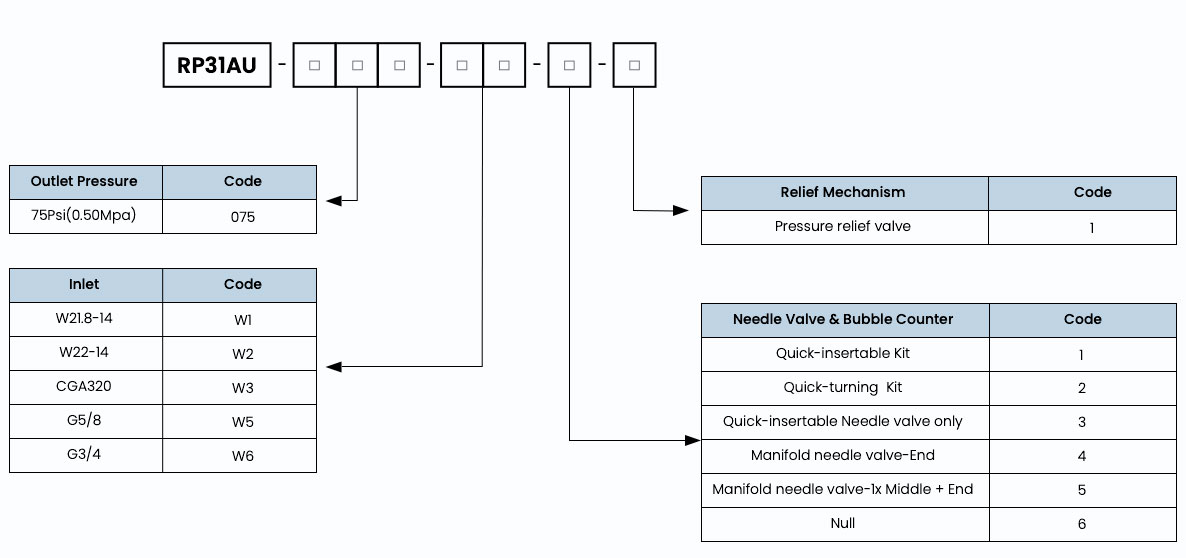
* Ordering code = Model + "-" + Outlet Pressure+"-"+Inlet+"-"+ Needle Valve & Bubble Counter+"-"Relief Mechanism
Example: RP31AU-075-W1-1-1
Contact Us to Place Your Order
Get quotations, request custom configurations, or receive technical support
Contact Us Now
A dual gauge pressure regulator sits between a gas source and whatever it feeds — a grow room CO2 line, a welding torch, a beverage carbonation system — and its job is easy to underestimate. It steps down high, unpredictable supply pressure into a steady, usable output, and it lets the operator watch both sides of that transformation at the same time. That second dial is what separates a dual gauge gas regulator from a basic single-dial unit: instead of guessing how much gas is left in the tank, or trusting that the downstream pressure hasn't drifted, the operator reads inlet supply and regulated outlet pressure side by side, in real time. Across hydroponics, industrial gas handling, and general fluid control, that second reading turns a routine fitting into an actual monitoring point.
Most pressure-related downtime doesn't come from a sudden failure — it comes from finding out too late that a supply tank was nearly empty, or that downstream pressure had quietly crept up without anyone noticing. A single-gauge setup only ever tells half of that story. A Dual Gauge Pressure Regulator tells both halves at once, which is why it has become the default choice anywhere gas supply needs to be tracked as closely as gas delivery.
| Application | Typical Outlet Range | Why Dual Gauge Helps |
|---|---|---|
| Hydroponic CO2 enrichment | Low, steady flow | Tank depletion tracked without opening the grow room |
| Inert gas welding | Moderate flow | Outlet drift caught before it affects weld quality |
| Beverage carbonation | Low, constant pressure | Consistent pour pressure across a shift |
The difference shows up clearly when the two setups are compared side by side. A single-gauge regulator can be perfectly stable and still leave an operator guessing about supply; a dual-gauge unit closes that gap without changing anything else about how the regulator performs.
At Ningbo Noursun Industrial Co., Ltd, a dual gauge only earns its second dial if both gauges stay accurate over years of use — a loose seat, an inconsistent needle valve, or a poorly calibrated dial makes the second reading worthless. That's the reasoning behind adopting zero-defect management and integrated R&D-to-manufacturing, so that the transition from a design requirement to a finished, calibrated regulator stays seamless from demand all the way through to delivery, rather than treating design and production as two separate handoffs.
None of that happens on its own. It comes from building a talent symbiotic system that aligns individual skill and judgment on the production line with the company's own performance goals, so the people calibrating a regulator have a direct stake in getting it right the first time. Every product is crafted with that same care, which is what keeps a regulator's outlet reading trustworthy long after it leaves the factory.
When data drives equipment and algorithms predict demand, intelligent manufacturing starts redefining the logic of production itself. Equipment networks connected through the Internet of Things, tied together by an Industrial Internet efficiency layer, mean every step of building a Dual Gauge Gas Regulator — from raw brass and seal material to final gauge calibration — can carry a "smart gene" that makes it traceable.
This isn't just equipment upgrading for its own sake — it's a different way of coordinating people, machines, and materials, aimed squarely at cost, quality, and delivery speed working together instead of trading off against each other.
It's worth a quick glance at both, since it takes seconds and catches two different problems — a low inlet reading flags a tank that needs attention soon, while an outlet reading that's off from normal flags a regulator or downstream issue.
A full tank rules out supply as the cause, which narrows the problem to the regulator itself — usually a seat, spring, or calibration issue rather than anything on the gas source side.
No — the second gauge adds a reading, not a step. Fitting, connection, and flow adjustment work the same way; the only difference is having a supply-side number to check alongside the delivery-side one.
By integrating R&D, manufacturing, and service so that feedback from one stage reaches the others quickly. Ningbo Noursun Industrial Co., Ltd treats that integration as the foundation for continuing to improve, rather than something finished once a design is approved.
ADD: No. 50, Zhongxing East Road, Xikou Town, Fenghua District, Ningbo City, Zhejiang Province, P.R. China
0086-574-88881358
0086-574-88473625
About Us
Industry Applications
News & Events
