
 简体中文
简体中文
 English
 Français
 日本語
日本語
 Deutsch
0086-574-88881358
0086-574-88473625

RP32-Dual Stage CO2 Regulator with Manometer
A dual stage pressure regulator for the aquarium market, featuring an external pressure relief valve, solenoid valve, needle valve and bubble counter. The inlet is compatible with US, EU, JP, and CN CO2 cylinder standards.
Integrates a pull-ring safety valve, dual gauges.
Quick-connect outlet for easy solenoid valve installation.
Flange connection support.
Two-stage reduction mechanism ensures precision and stability.
Error below ±1 bubble per minute, providing stable pressure and finer bubble output.
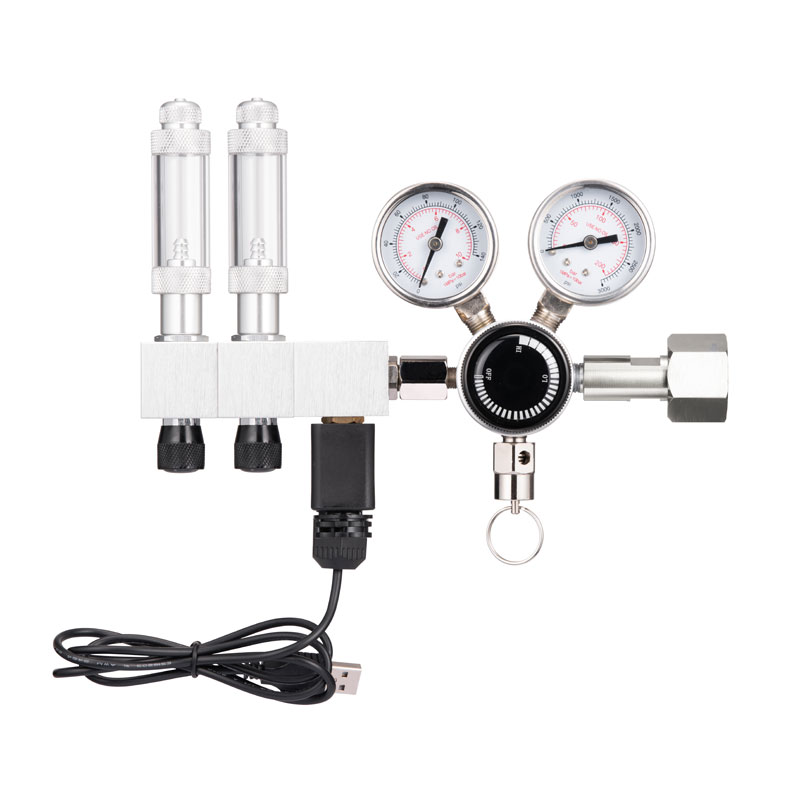
| Material | ▲ | Aluminum | |||
| Medium | CO2 | ||||
| Operating Temperature | -5℃~43℃ | ||||
| Max. Working Pressure | 12Mpa | ||||
| Proof Pressure | 30Mpa | ||||
| Output Pressure | ▲ | 0-0.5Mpa | |||
| Output Pressure Accuracy | ±0.02MPa | ||||
| Pressure Indication | ▲ | Y40 dual pressure gauges for inlet and outlet | |||
| outlet Pressure Indication | 0-140psi | ||||
| Indication Accuracy | Class IV (EN 837-1) | ||||
| Inlet Port | ▲ | W21.8-14 / W22-14 / CGA320 / G5/8 / G3/4 | |||
| Outlet Port | ▲ | G1/8 / 1/8NPT | |||
| Solenoid Valve | DC12V 3W,DC connector, IP65, Power Plug | ||||
| Power Plug | CN/US/EU/UK/JP/KR/AU | ||||
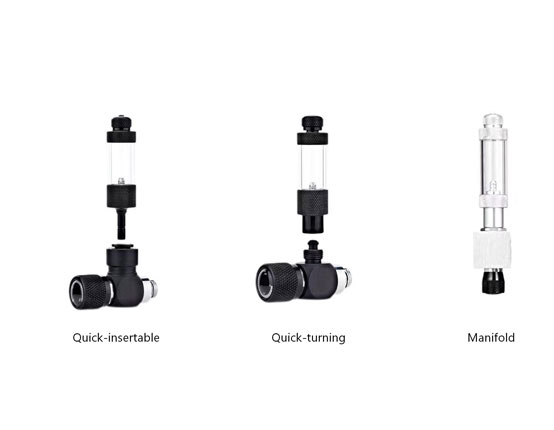
| Bubble Counter | Quick-insertable/Quick-turning | ||||
| Net Weight | 973g | ||||
| (▲ marked parts are standard parameters available for customization.) | |||||
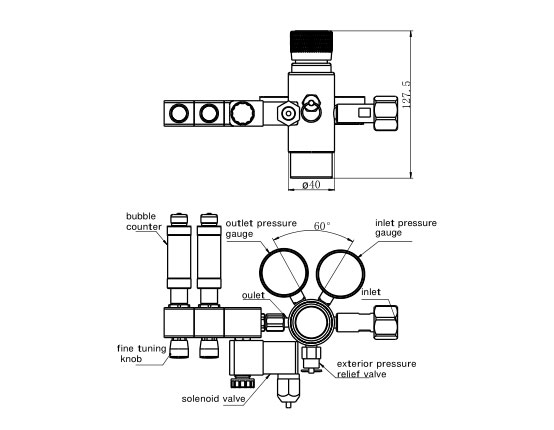
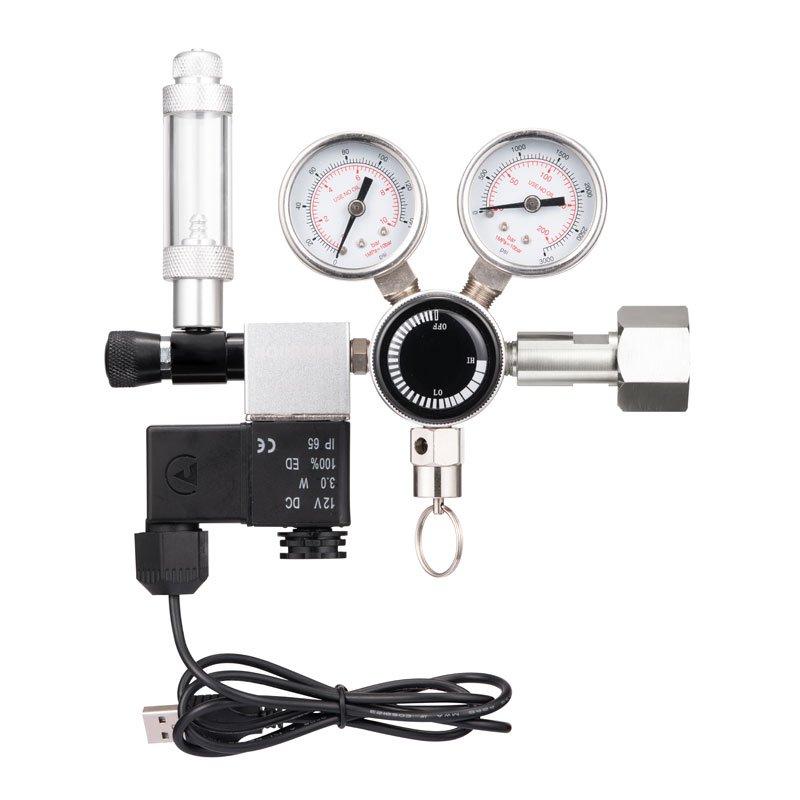
| Material | ▲ | Aluminum | |||
| Medium | CO2 | ||||
| Operating Temperature | -5℃~43℃ | ||||
| Max. Working Pressure | 12Mpa | ||||
| Proof Pressure | 30Mpa | ||||
| Output Pressure | ▲ | 0-0.5Mpa | |||
| Output Pressure Accuracy | ±0.02MPa | ||||
| Pressure Indication | ▲ | Y40 dual pressure gauges for inlet and outlet | |||
| outlet Pressure Indication | 0-140psi | ||||
| Indication Accuracy | Class IV (EN 837-1) | ||||
| Inlet Port | ▲ | W21.8-14 / W22-14 / CGA320 / G5/8 / G3/4 | |||
| Outlet Port | ▲ | G1/8 / 1/8NPT | |||
| Solenoid Valve | DC12V 3W,DC connector, IP65, Power Plug | ||||
| Power Plug | CN/US/EU/UK/JP/KR/AU | ||||
| Bubble Counter | Quick-insertable/Quick-turning | ||||
| Net Weight | 863g | ||||
| (▲ marked parts are standard parameters available for customization.) | |||||
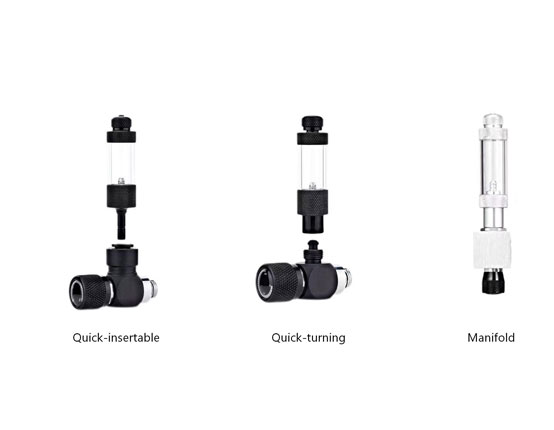
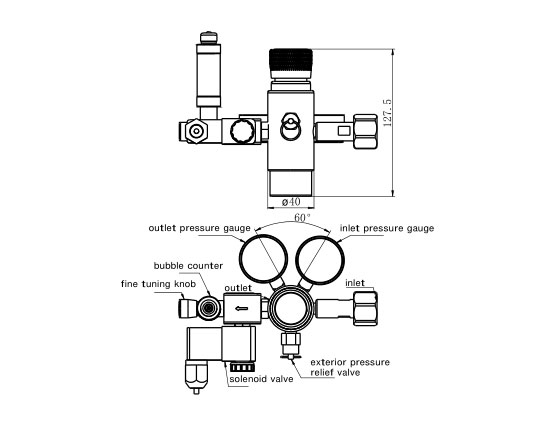
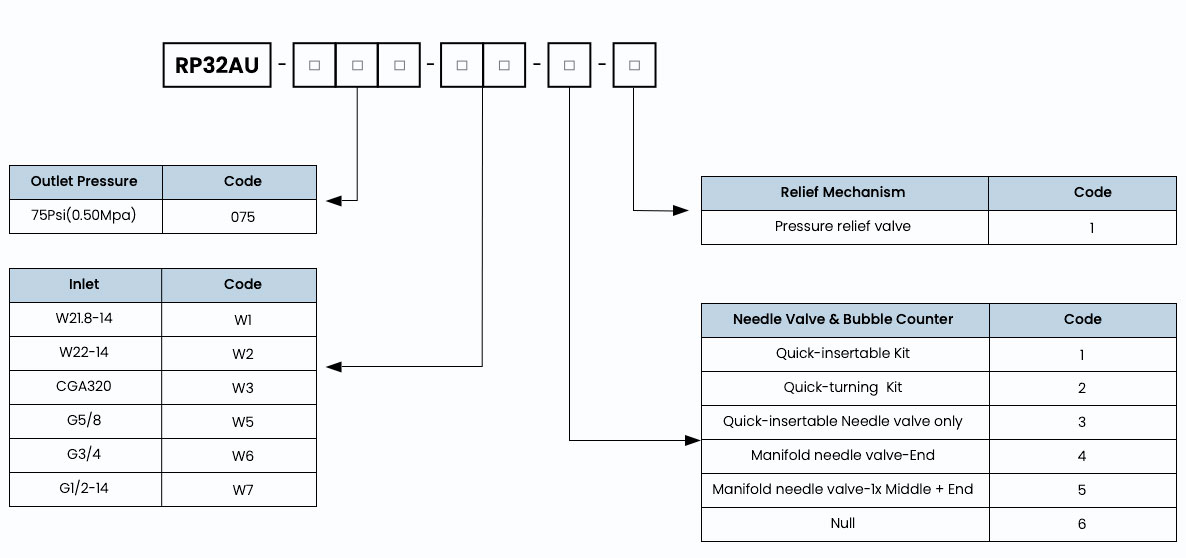
* Ordering code = Model + "-" + Outlet Pressure+"-"+Inlet+"-"+ Needle Valve & Bubble Counter+"-"Relief Mechanism
Example: RP32AU-075-W1-1-1
Contact Us to Place Your Order
Get quotations, request custom configurations, or receive technical support
Contact Us Now
A dual stage CO2 regulator with manometer is built around one job: taking the high, constantly falling pressure inside a CO2 cylinder and turning it into a flat, dependable working pressure that a grow room, greenhouse, or aquascape can actually rely on hour after hour. The term covers two linked ideas working together — a two-step pressure reduction path, and a manometer (the dual gauge) that shows both what is left in the tank and what is being delivered downstream. Anyone shopping for a dual stage co2 regulator is really asking one question: will this hold its output steady across the full life of a cylinder, or will it start drifting once the tank gets low? The sections below walk through how that stability is achieved, how to read the gauges correctly, and where the practical differences between regulator types actually show up in daily use.
At Ningbo Noursun Industrial Co., Ltd, the starting point for a regulator design is the failure mode it needs to avoid, and for CO2 that failure mode has a name growers already know: end-of-tank dump. A CO2 cylinder holds most of its gas as liquid, and while that liquid is present, cylinder pressure stays fairly constant. Once the liquid is gone and only gas vapor remains — typically the last portion of the fill — pressure inside the tank begins to fall quickly, and a regulator with only one reduction stage can let that instability pass straight through to the output side. The plants, or the aquarium, then receive a sudden surge of CO2 instead of the steady dose that was set.
Splitting the pressure drop into two stages solves this by design rather than by attention. The first stage brings the cylinder pressure down to a fixed intermediate pressure; the second stage then steps that intermediate pressure down to the working pressure the grower actually set. Because the second stage is only ever working from a stable intermediate value, whatever is happening inside the cylinder stops being its problem. The chart below sketches what this looks like across a cylinder's life: a single-stage design holds steady early on but climbs once the tank runs low, while a properly built two-stage dual stage CO2 regulator keeps working pressure flat right up until the cylinder is genuinely empty.
Illustrative pressure behavior across a cylinder's fill life, not measured data from a specific unit.
The manometer on a Dual Stage CO2 Regulator with Manometer is not one gauge doing two jobs — it is two separate gauges, each answering a different question. The high-pressure gauge reads the cylinder's internal pressure and functions as a fuel gauge: as liquid CO2 turns to gas and is used up, that reading drops in a way that roughly tracks how much is left, giving a grower advance warning before a refill is needed. The low-pressure gauge, downstream of both regulation stages, reads the working pressure actually being delivered to the tubing, needle valve, or diffuser. Comparing the two at a glance is what lets someone confirm the regulator is doing its job — cylinder pressure falling on its own schedule while working pressure sits still.
Working pressure itself is not one universal number; it is set according to the size of the space being enriched and how many outlets are drawing from the same regulator. Through the internationally adopted APQP (Advanced Product Quality Planning) framework we follow from concept through mass production, we treat this working-pressure range as a design input rather than an afterthought, since a regulator built for a single small enclosure behaves differently once it has to feed several diffusers at once. The ranges below are typical starting points, not fixed rules — most setups need some fine adjustment at the needle valve regardless of the base pressure selected.
General working-pressure starting points by enrichment area; actual settings vary by tubing length, number of outlets, and diffuser type.
On paper, both regulator types look similar: a knob, a needle valve, a gauge or two. The practical gap shows up in four places — how steady the output stays as the tank empties, how much of the cylinder's contents can be used before adjustments are needed, how often a grower has to physically re-tune the working pressure, and the upfront cost of the unit. A single-stage regulator tends to win only on price; a two-stage design wins on the first three, which is why most CO2 enrichment setups that run unattended for long stretches — timers, solenoids, no one checking daily — lean toward dual stage.
Relative comparison: dual-stage (solid red) vs single-stage (dashed gray) across four practical factors.
Before any of this reaches a production line, we validate it digitally: our finite element simulation system runs structural strength and fluid dynamics analysis on a design using CAE/CAD/CAM tools before a physical prototype is ever machined, which is how a two-stage internal path gets proven out for consistent flow ahead of tooling rather than discovered as a problem after it. It is also the reason a dual stage co2 regulator from a properly engineered line behaves the same on the hundredth unit as it did on the first prototype.
Not every day, but a quick glance now and then is worth it. The cylinder-pressure gauge is your early warning for a refill; the working-pressure gauge tells you whether the second stage is holding the number you originally set. If the working-pressure needle has moved on its own without you touching the adjustment knob, that is the one signal worth investigating right away.
Flow through a needle valve or diffuser is governed by the pressure right before it, not by how full the cylinder is. Two cylinders at completely different fill levels will deliver the same dose as long as working pressure downstream is identical — which is exactly the behavior a two-stage design is meant to guarantee.
Yes, within the flow capacity of the unit, though every added outlet is effectively another draw on the same working pressure. Splitting output across several tubing runs or diffusers usually calls for setting the working pressure a bit higher than a single-outlet setup would need, then fine-tuning each branch at its own needle valve.
That is the point of the two-stage path — no. A single-stage unit often needs the working pressure nudged back down as the cylinder empties out; every pressure regulator we run through our own testing lab is checked under durability, environmental adaptability, mechanical strength, and safety-limit conditions specifically so that a two-stage design keeps its set point untouched from a full cylinder to an empty one, without manual correction along the way.
ADD: No. 50, Zhongxing East Road, Xikou Town, Fenghua District, Ningbo City, Zhejiang Province, P.R. China
0086-574-88881358
0086-574-88473625
About Us
Industry Applications
News & Events
