
 简体中文
简体中文
 English
 Français
 日本語
日本語
 Deutsch
0086-574-88881358
0086-574-88473625

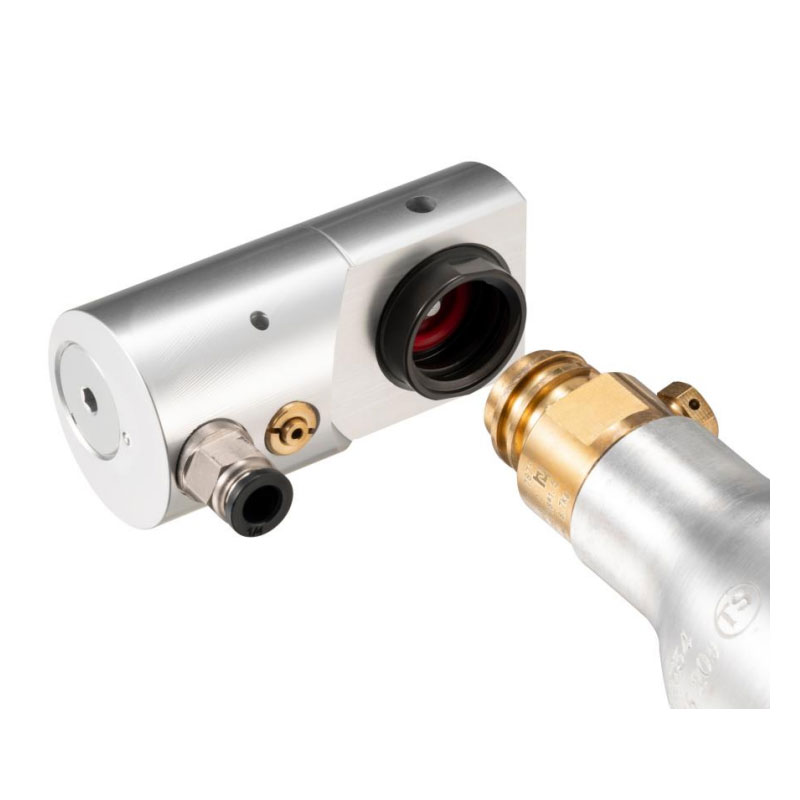
RP13-Sparkling Water CO2 Regulator
An upgraded version of the RP12, designed for carbonated sparkling water machines, is installed inside the unit. Ideal for customers with specific requirements regarding air outlet direction or mounting bracket position.
The pressure relief mechanism reduces the height of the pressure regulator, saving space inside the sparkling water machine.
Different inlet port types meet the connection requirements of various soda CO₂ cylinders.
The Zero-Leakage Valve-Actuation Mechanism ensures maximum gas utilization during the bottle-opening process.
| Material | ▲ | Aluminum | ||
| Medium | CO2 | |||
| Operating Temperature | ‑5℃~43℃ | |||
| Max.Working Pressure | 12Mpa | |||
| Proof Pressure | 30Mpa | |||
| Output Pressure | ▲ | 0.35Mpa≤preset pressure≤0.55Mpa | ||
| Output Pressure Accuracy | ±0.03MPa | |||
| Inlet Port | ▲ | TR21×4 / φ21-6ACME / G1/2-14 / M22*2.5 | ||
| Outlet Port | ▲ | 1/4" / 6mm quick connector / G1/8 | ||
| Relief pressure(LP side) | Built-in pressure relief valve | |||
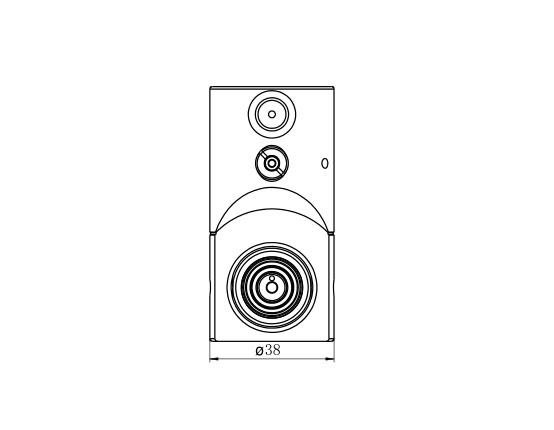
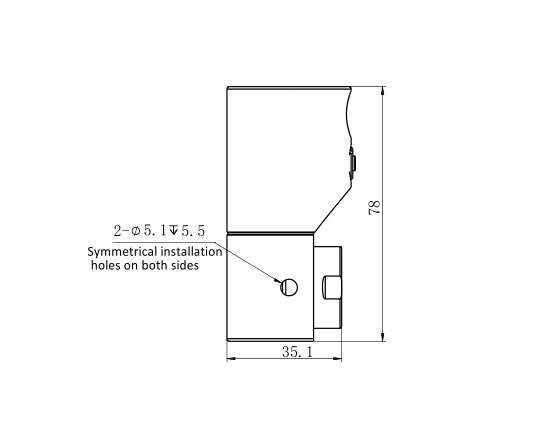
| Mounting | ▲ | Null / M5.1 on the side | ||
| Net Weight | 204g | |||
| (▲ marked parts are standard parameters available for customization.) | ||||
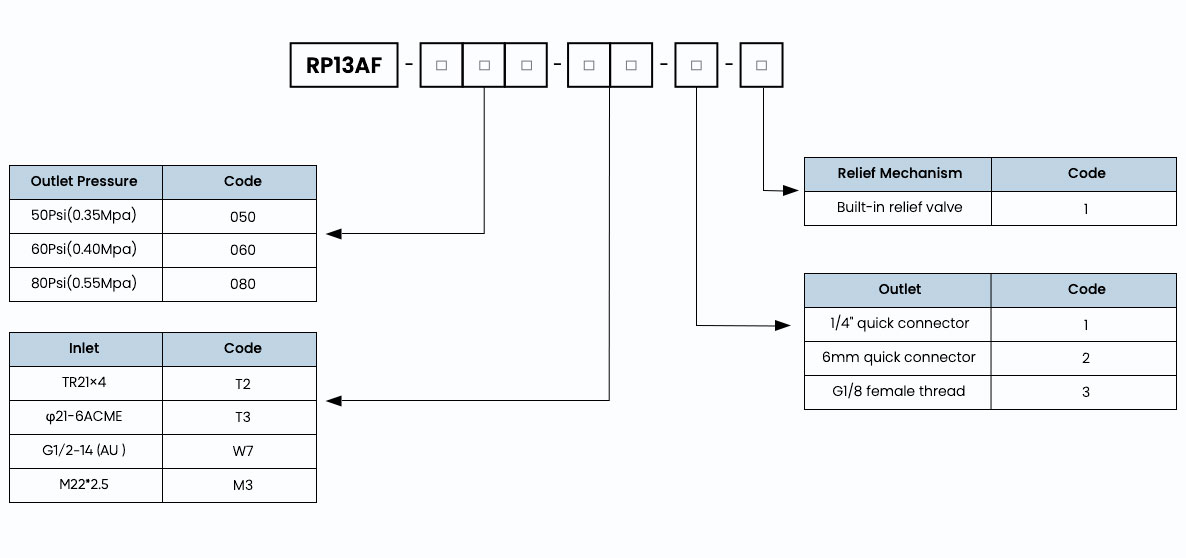
* Ordering code = Model + "-" +Outlet Pressure+"-" + Inlet+"-"+Outlet+"-"+Relief Mechanism
Example: RP13AF-060-T2-1-1
Contact Us to Place Your Order
Get quotations, request custom configurations, or receive technical support
Contact Us Now
A sparkling water CO2 regulator is the small but decisive component that turns a raw gas cylinder into a controllable carbonation source. It sits between the CO2 tank and the delivery line, stepping high cylinder pressure down to a stable working pressure and holding it steady even as the tank empties. The category covers far more than household soda machines — it extends into commercial beverage lines, cosmetic dosing equipment, agricultural dosing systems, and precision lab-style delivery, all of which depend on the same core principle of controlled, repeatable gas pressure.
Not every sparkling beverage is carbonated to the same intensity, and the regulator's output setting has to match the target fizz level rather than run at a single fixed number. Lightly effervescent water needs a gentler push than a classic soda profile, while high-carbonation styles demand notably more headroom. Running a regulator too low under-carbonates the batch; running it too high risks foaming, gushing, or premature seal wear.
Because these ranges vary so widely, a Sparkling Water CO2 Regulator is generally built with a broader adjustable dial rather than a single locked setting, so the same unit can be dialed toward a lighter style one day and a punchier profile the next — a flexibility that manufacturers such as Ningbo Noursun Industrial Co., Ltd have leaned into when designing regulators meant to serve both home and small commercial setups.
At Ningbo Noursun Industrial Co., Ltd, we've found that the same CO2 source often needs to feed very different downstream equipment — a soda maker, a beer font, a dosing pump for carbonated skincare, or an injection line for hydroponics — and each of those has its own tolerance for pressure and flow. A regulator that performs well on one system can behave unpredictably on another if the output range isn't matched properly.
| Application | Typical PSI | Flow Behavior |
|---|---|---|
| Home Soda Making | 15–40 | Short bursts, frequent adjustment |
| Beer Dispensing | 10–14 | Continuous, low variance |
| Carbonated Skincare Dosing | 20–35 | Precise, low-volume pulses |
| Hydroponic CO2 Injection | 8–20 | Slow, steady release |
The practical takeaway is that a regulator's dial range matters more than its maximum output alone — a unit that can only step down to 20 PSI is a poor fit for beer conditioning, no matter how well it holds pressure at the top end.
A regulator that reads accurately on day one won't necessarily hold that accuracy indefinitely. Seals soften, springs relax slightly under repeated cycling, and small amounts of drift can creep in well before a unit shows any visible fault. Left unchecked, this drift shows up as gradually flatter drinks or, in the opposite direction, unexpected foaming.
A simple maintenance habit keeps this predictable:
This is one of the reasons the Sparkling Water CO2 Regulator category has moved toward simpler dial mechanisms in recent product generations — fewer moving parts translates into fewer places for drift to originate, which is a design priority we keep returning to at Ningbo Noursun Industrial Co., Ltd when refining regulator internals.
Sparkling water is only one branch of a much wider tree of CO2 regulation needs. The same underlying pressure-control logic shows up in beer dispensing, carbonated skincare, pest control fumigation, hydroponics dosing, and veterinary applications — but the priority given to precision, portability, or hygiene shifts from one field to the next. Serving industries across Europe, North America, East Asia, and Australia has made this variation something Ningbo Noursun Industrial Co., Ltd designs around directly, rather than treating regulators as one-size-fits-all hardware.
Red: beverage carbonation profile · Grey: adjacent dosing applications profile (illustrative)
Beverage carbonation tends to demand wider pressure range flexibility and frequent cycling, while dosing-style applications such as carbonated skincare or veterinary use lean harder on hygiene and fine precision at lower flow volumes. Recognizing which axis matters most for a given use case is usually the fastest way to narrow down the right regulator configuration.
Generally yes, but only within the range the water and container can handle. Beyond a certain point, extra pressure mostly produces foaming and gas loss rather than additional dissolved CO2.
Only if its adjustable range genuinely spans both use cases. Many regulators are tuned toward one end of the pressure spectrum, so it's worth checking the low and high limits before assuming cross-application use.
For frequent daily use, a quick check every few weeks is a reasonable habit; lighter or occasional use can be checked less often, but any noticeable change in taste or fizz is a good prompt to check sooner.
Higher pressure settings push more gas through per cycle, so a tank set for high-carbonation soda will naturally empty sooner than the same tank running a lightly sparkling profile.
ADD: No. 50, Zhongxing East Road, Xikou Town, Fenghua District, Ningbo City, Zhejiang Province, P.R. China
0086-574-88881358
0086-574-88473625
About Us
Industry Applications
News & Events
