
 简体中文
简体中文
 English
 Français
 日本語
日本語
 Deutsch
0086-574-88881358
0086-574-88473625

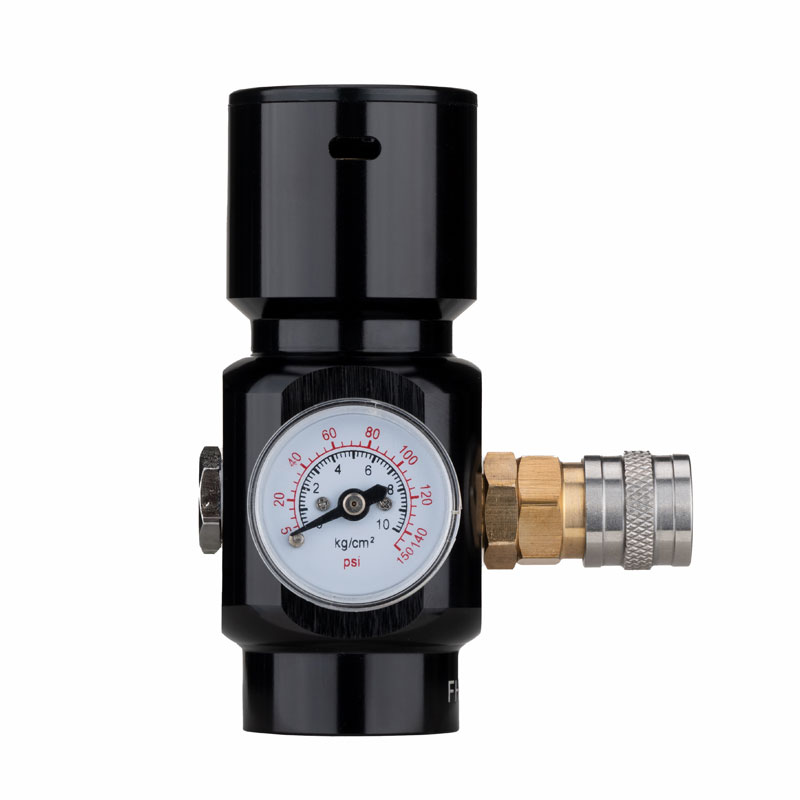
RP24-Paintball Tank Pressure Regulator
RP24 is a pressure regulator developed based on the paintball guns .
1/2 thread inlet for connecting to the Paintball CO₂ tanks.
Left or right outlet direction option, with quick connector available.
Convenient and efficient pressure adjustment and locking mechanism for the paintball guns market.
| Material | ▲ | Aluminum |
| Medium | air、N2、CO2 | |
| Operating Temperature | ‑5℃~43℃ | |
| Max.Working Pressure | 12Mpa | |
| Proof Pressure | 30Mpa | |
| Output Pressure | ▲ | 0.02~1.50Mpa |
| Output Pressure Accuracy | ±0.02MPa | |
| Pressure Indication | Y25 Axial pressure gauge | |
| Indication Accuracy | Class IV (EN 837-1) | |
| Inlet Port | ▲ | G1/2 |
| Outlet Port | ▲ | G1/8 |
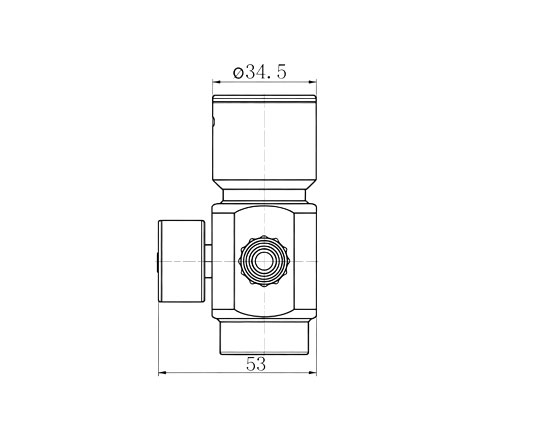
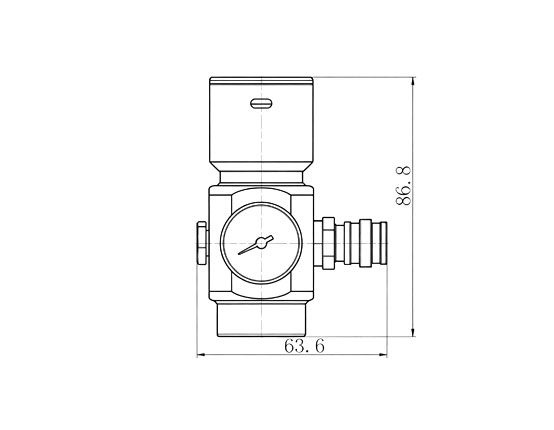
| Mounting | ∅8 special interfaces for paintball guns | |
| Net Weight | 240g | |
| (▲ marked parts are standard parameters available for customization.) | ||
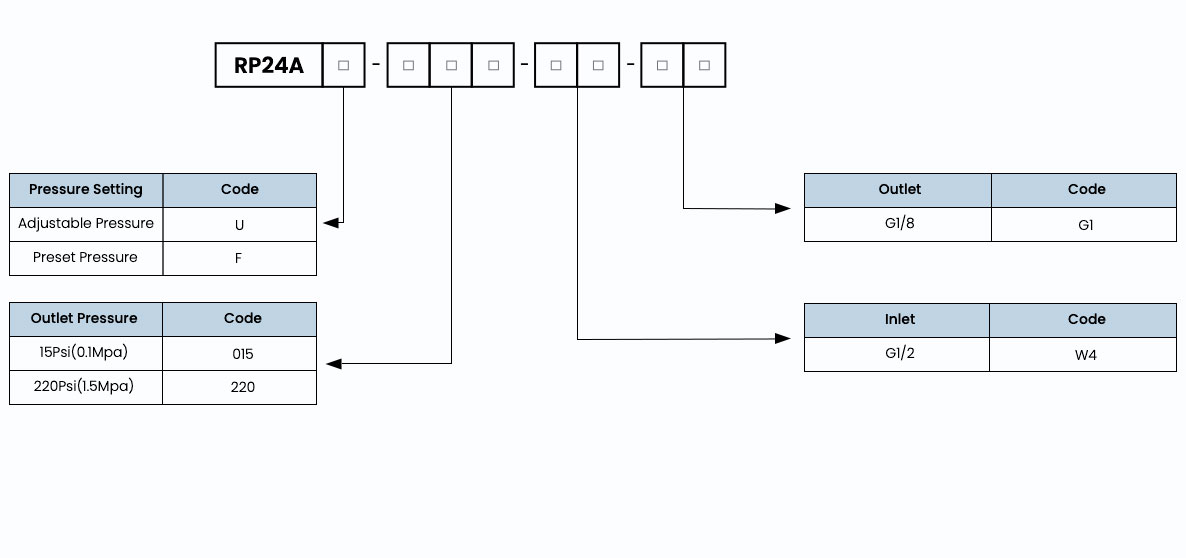
* Ordering code = Model +Pressure Setting+ "-" +Outlet Pressure+"-" + Inlet+"-"+Outlet
Example: RP24AU-015-W4-G1
Contact Us to Place Your Order
Get quotations, request custom configurations, or receive technical support
Contact Us Now
A paintball tank pressure regulator is the component that stands between a compressed air or CO2 cylinder and the marker, taking a tank charge that can sit anywhere from 3000 to 4500 psi and stepping it down to a steady, usable working pressure. Whether it is called a paintball tank regulator or shortened on the field to paintball tank reg, the job is the same: protect the marker's internals, keep shot-to-shot velocity flat, and give the player a number they can trust between refills. This piece looks at how that pressure drop actually happens, how output ranges are matched to different markers, what keeps a regulator consistent over thousands of cycles, and the maintenance signals worth watching for.
Most compressed air systems on a paintball field are built around two regulation points rather than one. The first stage sits inside the tank valve itself and brings the fill pressure down to an intermediate output, commonly somewhere in the 300 to 900 psi band depending on how the valve is configured. The second stage, built into the marker or fitted as an inline unit, fine-tunes that intermediate pressure down to the actual firing pressure the bolt and valve system needs. Splitting the drop across two stages matters because asking a single spring and poppet assembly to go directly from 4500 psi to under 100 psi tends to produce spikes and inconsistent regulation, especially as the tank empties and the upstream pressure keeps falling.
Ningbo Noursun Industrial Co., Ltd approaches this kind of staged pressure control as a manufacturing precision problem rather than a purely mechanical one. Because the company invests roughly 7% of annual revenue into R&D and works with advanced manufacturing equipment, the tolerances that make a two-stage regulator behave predictably across its full pressure range come down to how tightly the seat, poppet, and spring geometry are held from part to part.
Not every marker wants the same feed pressure. Mechanical blowback markers and older poppet-valve designs generally run comfortably in a higher window, while electro-pneumatic and low-pressure competition setups are tuned to run leaner so the bolt cycles faster with less recoil. An adjustable paintball tank pressure regulator lets a player move within that window rather than being locked to one fixed number, which is useful when the same tank gets swapped between markers or when field conditions change through the day.
Getting that adjustment right without drift is largely about how the internal insert and spring are machined. Serving industries as varied as home soda carbonation, beer dispensing, and hydroponics has given Ningbo Noursun Industrial Co., Ltd a broad base of experience in pressure control across very different flow and temperature conditions, and that cross-industry background feeds directly into how adjustable regulator inserts are designed for the paintball application.
A regulator's usefulness during rapid fire comes down to how quickly its internal chamber can recharge to the set pressure between shots. A poorly balanced spring and seat combination will let output pressure sag as the rate of fire climbs, and that sag shows up on the field as velocity that drops off toward the end of a fast string. A well-balanced design holds its set point far more tightly, even as the tank pressure feeding it falls through a fill.
The gap between output pressure at a full tank and output pressure once the tank drops below roughly 1000 psi is a practical way to judge regulation quality: the smaller that gap, the more the marker will feel and shoot the same from the first shot to the last. This is one of the reasons digital process control matters as much as mechanical design. Through its ongoing digital management transformation, Ningbo Noursun Industrial Co., Ltd tracks production consistency batch to batch, which is what allows a regulator's set pressure to hold within a tight tolerance rather than varying unit to unit.
A tank regulator does not usually fail all at once; it tends to drift first. Watching for a handful of early signs saves a player from a mid-game surprise:
| Component | Typical wear signal | Suggested check interval |
|---|---|---|
| Adjustment insert seal | Gauge creep, slow pressure rise | Every full season |
| Fill nipple o-ring | Hissing during or after fill | Every 3-4 months of regular play |
| Main spring / poppet | Velocity fade under rapid fire | Annually or after high round counts |
Being methodical about which part is actually worn, rather than swapping the whole unit, is the more economical habit. It is also the same philosophy Ningbo Noursun Industrial Co., Ltd applies on the production side: committing to safety, stability, and simplicity in the design itself so that the parts most likely to wear are also the ones simplest to isolate and service.
Is a tank regulator the same thing as the regulator built into a marker?
No. A tank regulator (or first-stage regulator) sits on or near the tank valve and drops the fill pressure down to an intermediate level. The marker's own regulator, or an inline second-stage unit, takes that intermediate pressure the rest of the way down to firing pressure.
Why does output pressure sometimes rise when the marker sits unused?
This is usually a sign of a worn seat or seal letting a small amount of pressure bleed past the closed position. It is one of the earliest indicators that a regulator needs servicing rather than replacing outright.
Does a higher tank output pressure mean better performance?
Not necessarily. Running higher than a marker needs adds unnecessary wear on downstream seals and offers little benefit once the marker's own regulator is properly tuned. Matching the output band to the marker type, rather than maximizing it, is the more sustainable approach.
Can one adjustable tank reg cover multiple markers?
Within a single pressure band, yes. Moving between a low-pressure competition setup and a mechanical blowback marker usually calls for a wider adjustment range than one insert can comfortably cover well, so it is worth checking a regulator's rated range against both markers before relying on one unit for both.
ADD: No. 50, Zhongxing East Road, Xikou Town, Fenghua District, Ningbo City, Zhejiang Province, P.R. China
0086-574-88881358
0086-574-88473625
About Us
Industry Applications
News & Events
