
 简体中文
简体中文
 English
 Français
 日本語
日本語
 Deutsch
0086-574-88881358
0086-574-88473625

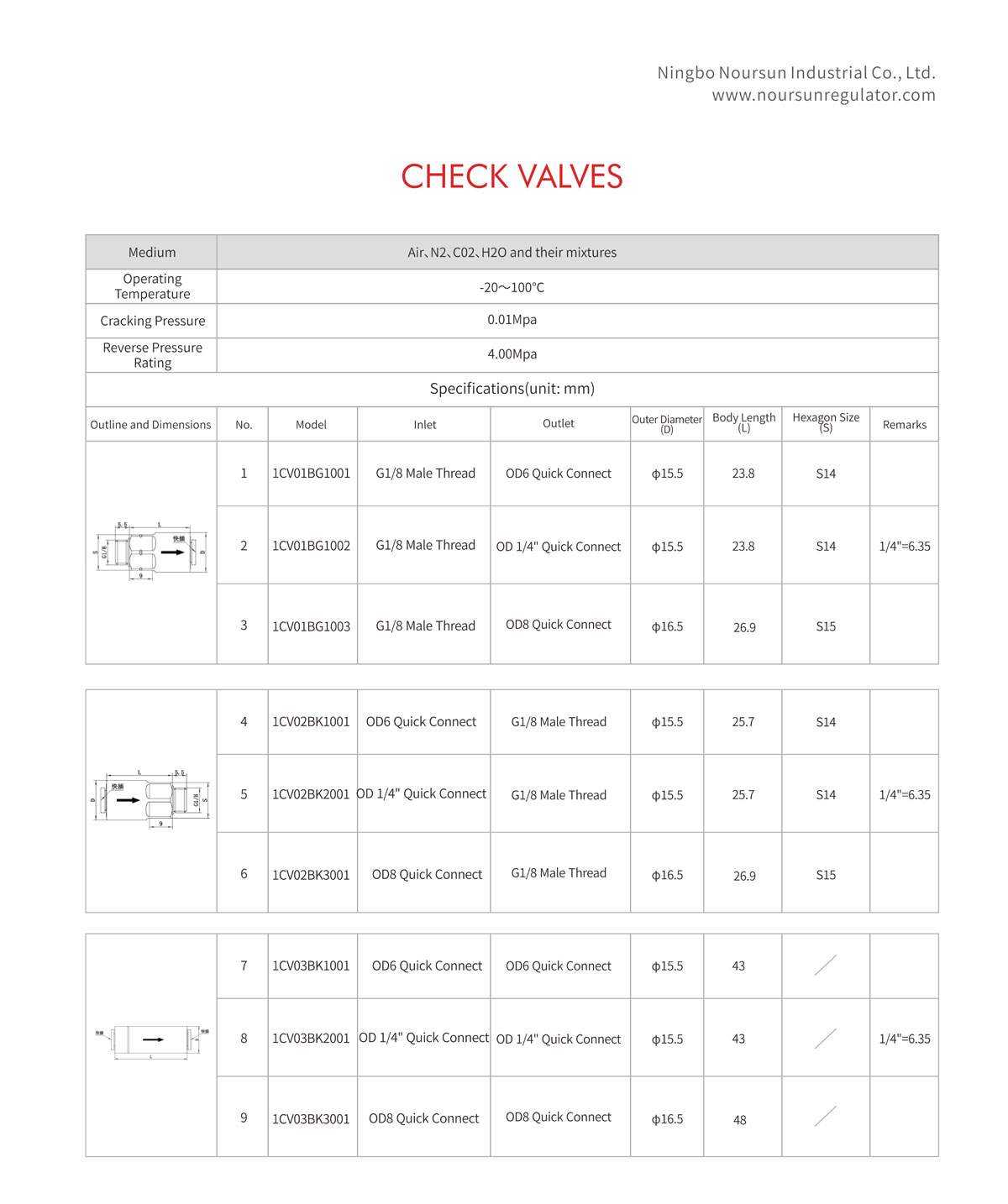
Check Valves form one of the most functionally critical categories within fluid and gas control hardware, engineered to allow flow in a single direction while blocking any reverse pressure that could damage upstream components or contaminate a system. Across applications ranging from carbonation lines to industrial gas delivery, engineers distinguish between a high pressure check valve built for demanding line conditions and a low pressure check valve suited to more delicate, low-flow circuits. Where flow behavior needs fine adjustment, an adjustable check valve lets operators set the exact opening point, while a gas check valve is purpose-built for compressible media handling. Together, these variations are often grouped under the broader term pressure check valve, reflecting their shared role in keeping pressure directional, consistent, and predictable.
At Ningbo Noursun Industrial Co., Ltd, pressure control is treated as a system problem rather than a single-part problem, which is why Check Valves are usually specified alongside regulators rather than chosen in isolation. A check valve works through a spring-loaded disc, poppet, or ball that seats against flow the moment pressure tries to reverse direction. The force needed to lift that seat off its seal is called the cracking pressure, and it is this single number that determines whether a valve responds quickly enough to protect the rest of the line.
Two design details separate a well-matched valve from a poorly matched one: response lag and reseal tightness. A valve with too much internal resistance opens late, letting a pressure spike travel further into the system before it is stopped. One with too little resistance can chatter open and closed under normal flow variation, causing premature wear on the seal.
The chart above illustrates why category selection matters more than brand comparison: a valve rated for one range simply is not interchangeable with one built for another, regardless of thread size or outward appearance.
A high pressure check valve is typically built with a heavier spring rate, a hardened seat, and a body wall rated for repeated pressure cycling. It is the correct choice wherever compressed gas cylinders, CO2 supply lines, or bottling equipment feed a system, since a sudden drop in upstream pressure must not allow product or gas to travel backward into the source. Design and testing decisions like this sit at the center of how Ningbo Noursun Industrial Co., Ltd approaches its pressure control component line, since the same valve body cannot reliably serve both a beer dispensing rig and a home carbonation unit.
A low pressure check valve, by contrast, uses a lighter spring so it can crack open with minimal input pressure, which matters in applications like carbonated skincare misting or veterinary dosing lines where the driving pressure is intentionally kept low for safety and dosing accuracy. Using an oversized, high-pressure-rated valve in this setting often means the system never reaches enough force to open the valve at all, and flow simply stalls.
| Attribute | Low Pressure Design | High Pressure Design |
|---|---|---|
| Spring rate | Light | Heavy |
| Typical use | Dosing, misting lines | Cylinder and gas supply |
| Seat material | Elastomeric, soft seal | Hardened, cycle-rated |
| Failure risk if oversized | Valve never opens | Premature wear, leakage |
An adjustable check valve gives an operator direct control over the cracking pressure through a set screw or threaded spring seat, which is useful when a single system runs several product lines with slightly different pressure targets. Rather than stocking multiple fixed-pressure valves, a facility can retune one component as the process changes.
A gas check valve presents a different engineering challenge, since compressible gases behave differently from liquids at the moment of reversal. Gas can compress slightly before a valve fully seats, so seal geometry and disc mass are tuned to minimize that lag. The list below summarizes the practical differences a specifier should weigh:
As line pressure rises, response lag typically shortens because the pressure differential itself does more of the work of seating the valve, which is one reason gas check valve testing is usually run across a full pressure sweep rather than a single set point.
Choosing a pressure check valve ultimately comes down to matching four variables at once: media type, expected pressure range, cycle frequency, and the consequence of a failed seal. A radar comparison is often the clearest way to see how these variables trade off across valve families.
In practice, no single valve maximizes every attribute at once, which is why pressure control manufacturers offer families of valves rather than one universal part. Ningbo Noursun Industrial Co., Ltd operates from this same logic in its own product development, treating precision and consistency as the baseline requirement and then customizing spring rate, seat material, and body configuration around the specific process a customer describes.
This is also where digital production tracking earns its value: two valves built to the same specification months apart should behave identically, and consistent, well-documented manufacturing is what makes that repeatability possible at scale rather than by chance.
Flow is blocked entirely in the intended direction, since the valve is designed to seal against reverse flow. Most bodies are stamped with a flow-direction arrow, and installers should confirm orientation before pressurizing the line.
Some can, but performance is usually optimized for one media type. A valve tuned for gas response may not reseal as tightly under liquid hammer, and vice versa, so media-specific selection is generally the safer approach.
Inspection frequency depends on cycle count and media cleanliness rather than calendar time alone. High-cycle applications such as beer dispensing lines typically warrant more frequent checks than low-cycle, static gas supply setups.
Repeated vibration or thermal cycling can loosen a set screw over time. Locking the adjustment mechanism and periodically verifying cracking pressure keeps performance stable, a routine that Noursun recommends building into standard maintenance schedules for adjustable installations.
ADD: No. 50, Zhongxing East Road, Xikou Town, Fenghua District, Ningbo City, Zhejiang Province, P.R. China
0086-574-88881358
0086-574-88473625
About Us
Industry Applications
News & Events
