
 简体中文
 English
 Français
 日本語
 Deutsch
0086-574-88881358
0086-574-88473625


News
Nov 02, 2026
A five-pound CO2 cylinder sitting next to a home soda machine reads around 850 psi on a warm afternoon, while the carbonation head behind it wants about 45 psi. Everything between those two numbers depends on one component: the gas cylinder regulator. When it works, nobody notices it. When it drifts, the soda goes flat, the beer foams, the greenhouse crop stops responding, and the paintball marker starts shooting low. Here is the short answer for anyone choosing one: match the regulator to the gas first, then to the pressure range and flow the job actually needs, and only then decide between a single-stage and a dual-stage design. Thread standard, seat material, gauge count, relief valve rating, and body finish all follow from those three decisions. Buyers who start with price or with the shape of the body usually end up replacing the unit within a season. The rest of this page works through each decision with the numbers that matter at the bench and in the field: inlet ratings, outlet ranges, drift figures, connection standards, installation checks, and the failure patterns that appear after a few thousand cycles. A regulator is a pressure-reducing device, not a storage device and not a flow meter. Inside the body, a spring pushes down on a diaphragm, the diaphragm pushes on a valve stem, and the gas pressure underneath pushes back. The balance point between those two forces is the pressure you read on the delivery gauge. Turn the adjusting screw in, the spring loads up and the outlet pressure rises. Turn it back, the spring relaxes and the outlet falls. Every regulator on the market, from a small hobby unit to a laboratory two-stage assembly, is a variation on that mechanical feedback loop. Three numbers describe a regulator before anything else does: Pressure and flow are not the same job. A regulator holds pressure. A flow meter measures and displays flow. On a welding cart the two are often bolted together so the operator can set both at once. On a soda system the regulator does the pressure work while a small needle valve trims the flow. Confusing the two causes most sizing mistakes: a regulator that holds 45 psi perfectly can still starve a system if it can only pass 3 SCFH. Three behaviors tell you whether a regulator is healthy. Lockup is the small rise in outlet pressure when flow stops, and one to three psi above the set point is normal. Droop is the fall in outlet pressure when flow starts, and it stays small if the unit is sized correctly. Creep is a slow rise with the downstream valve shut, and that is not normal: more than one or two psi over ten minutes usually means contamination on the seat or a worn seat disc. A single-stage regulator reduces cylinder pressure to working pressure in one step. A dual-stage regulator does it twice. The first stage drops cylinder pressure to an intermediate level, often 200 to 500 psi, and the second stage trims that down to the working pressure. The extra stage costs more, weighs more, and buys one specific thing: stability as the cylinder empties. The reason it matters is the cylinder decay effect. As a CO2 cylinder empties, internal pressure falls from roughly 850 psi toward 300 psi over the life of the tank, and a single-stage regulator reacts to that change. In day-to-day field conditions, a single-stage unit commonly moves five to fifteen psi across a full cylinder at a fixed screw setting, while a dual-stage unit typically holds within one to three psi. For a home soda maker or an occasional paintball fill, a five psi drift changes nothing. For a bar pouring forty kegs a week, or a grow room dosing CO2 for sixteen hours a day, that same drift is the difference between consistent results and a service call. A simple rule: choose dual-stage when the outlet pressure is critical, when the cylinder is large, or when the unit runs continuously. Connection standards exist so that a CO2 regulator cannot be threaded onto an oxygen cylinder by mistake. Respecting them is not optional, and it is also the fastest way to narrow a product list down to the two or three options that will actually work. CO2 sits in the cylinder partly as a liquid, so its pressure stays almost flat while the tank empties and then falls off quickly at the end. A full cylinder at 20 degrees C reads about 830 psi; the same cylinder in a cold walk-in cooler can read nearer 500 psi. The CGA 320 connection with a nylon washer is the North American standard, while W21.8 and DIN 477 number 6 cover most of Europe and Asia. CO2 expands and cools sharply as it moves, so relief protection and moderate flow rates matter more here than with almost any other common gas. Inert gases are stored as compressed gas rather than liquid, so cylinder pressure falls in a straight line as the tank empties. Full argon cylinders sit around 2,000 to 2,600 psi at room temperature, and they use a CGA 580 connection in North America or W24.3 in many other markets. Because the decay curve is steady rather than flat, drift from a single-stage unit shows up gradually over the life of the cylinder, which is why dual-stage designs dominate welding, wine preservation, and laboratory work. For this class of duty, the RP04 dual stage argon regulator is built to take a full argon cylinder on the inlet and deliver a stable shielding or preservation pressure on the outlet. Paintball and airsoft tanks are rated to 4,500 psi and deliver 400 to 850 psi to the marker. Regulators in this class are usually preset at the factory or adjustable with a tool, and they live with repeated pressure spikes, so burst disc protection and a robust piston or diaphragm design matter more than fine gauge resolution. Once the gas and the stage count are settled, the specification sheet decides the outcome. These are the fields worth checking line by line before an order is placed. A regulator rarely fails on its own. Most early failures trace back to something that happened in the first twenty minutes after it left the box. The sequence below covers the checks worth doing every time. Most creep traces back to contamination, a damaged seat, or debris carried out of a cylinder. Fitting a sintered inlet filter and replacing the seat disc usually solves it. If the same regulator creeps again within a month, the cylinder itself may be the source of the debris. CO2 cools as it expands, and a regulator pushed beyond its flow rating will frost over the body and bonnet. Icing usually points to a flow rate that is too high for the unit or moisture in the gas. Keep the cylinder upright, reduce flow, and check for a partially blocked line downstream. Overpressure, a wrong-range setting, or simple age hardening of the elastomer. It announces itself with gas venting from the bonnet or a sudden spike on the delivery gauge. A diaphragm that has been creased during installation can fail the same way. Vibration and repeated shocks kill gauges faster than pressure does. Liquid-filled gauges hold up better on carts, mobile equipment, and any installation where the regulator is bolted to something that moves. Temperature cycling loosens joints over time. A bonnet that needs retightening every few weeks is usually a sign of a compressed or hardened seal rather than a loose screw. Seat and nozzle damage keeps gas flowing even with the adjusting screw fully backed out. Replace the seat assembly or the unit, and find out what damaged it before putting a new regulator on the same cylinder. Pressure control looks like one discipline from a distance, but each industry pulls the same components in a different direction. Our application overview shows how one family of regulators and valves is reused across them. A typical home soda machine carbonates between 40 and 60 psi. Standard carbonation tables put three volumes of CO2 at four degrees C at roughly 40 psi of equilibrium pressure, so the regulator has to hold a narrow band while the cylinder drains from full to empty. A check valve downstream of the regulator keeps carbonated water from pushing back into the gas path, and a safety valve protects the bottle if the pressure control ever sticks. In compact countertop machines, the RP02 mini CO2 regulator keeps the footprint small without giving up the relief protection. A kegerator pouring a standard ale at four degrees C and 2.5 volumes of CO2 runs about 10 to 14 psi of applied pressure, plus whatever the beer line resistance adds to the balance. Set it too low and the beer goes flat within a day; set it too high and the glass fills with foam. Because bars often change kegs mid-service, a regulator that holds its setting through repeated shutoffs and restarts saves real money in poured-out beer. The RP20 beer CO2 regulator is aimed directly at that duty. Greenhouse enrichment typically targets 1,000 to 1,500 ppm of CO2 during daylight hours, and planted aquariums run far lower flow rates but need the same stability. Regulators in this class usually set 15 to 30 psi at the outlet and feed a needle valve, a solenoid, and a bubble counter. A dual gauge layout helps because the operator can confirm that the cylinder still has pressure while reading the working pressure at the same time. Models such as the RP31 dual gauge pressure regulator, the RP32 dual stage CO2 regulator with manometer, the RP23 aquarium CO2 regulator, the RP14 aquarium pressure regulator, and the RP25 aquarium pressure regulator cover the spread of single-stage and dual-stage needs in this segment. Here the regulator lives on the tank itself and has to survive being dropped. Output sits between 400 and 850 psi depending on the marker, and the unit is judged on how little the velocity changes from the first shot to the last. The RP24 paintball tank pressure regulator is designed for that environment, where shock resistance matters as much as steady pressure. CO2 is also used for controlled-atmosphere pest treatment, for carbonated skincare products, and for gas delivery in veterinary equipment. Each of these applications asks for the same fundamentals: a stable reduced pressure, a reliable relief path, and seals that match the medium. When the medium or the flow profile changes, the regulator body often stays the same while the seat material, spring range, and connection change around it. Whether you are buying a hundred units for a soda machine line or a few thousand for a dispensing brand, the same questions separate suppliers that understand pressure control from suppliers that only assemble parts. Ningbo Noursun Industrial Co., Ltd. has been manufacturing gas pressure regulators and matching valves from Ningbo, China since 2012. The company supplies soda machine builders, beer dispensing brands, hydroponics equipment makers, and paintball manufacturers across Europe, North America, East Asia, and Australia, and puts roughly seven percent of annual revenue back into research and development. Its portfolio covers more than 35 granted patents, with around ten new applications filed each year, and its in-house test laboratory runs durability, environmental, and mechanical strength evaluations on production designs before they ship. More detail on the manufacturing side is available on the about page. A regulator reduces cylinder pressure and holds a set outlet pressure. A flow meter measures how much gas is actually moving, usually in SCFH or liters per minute. Some units combine both in one body, but they are separate functions. If your process depends on a specific gas volume rather than a specific pressure, you need the flow meter, and often a needle valve to trim the flow after the regulator. Not safely in most cases. The connection standards differ, the inlet pressure ratings differ, and the seals are selected for a particular gas. A CO2 regulator rated at 3,000 psi inlet might physically survive an argon cylinder, but the fitting will not match and the wrong seal material can degrade. Match the regulator to the gas, then confirm the connection standard before ordering. Most home soda machines work between 40 and 60 psi. The right number depends on the temperature of the water and the carbonation level you want, since cold water holds more CO2 at a lower pressure. A 0 to 60 psi regulator gives far better control in that band than a 0 to 160 psi unit, because the adjusting screw has more travel per psi of change. Creep with the downstream valve closed almost always means the seat is not sealing fully. Common causes are debris on the seat, a hardened or cut seat disc, or a damaged nozzle. A rise of one to two psi over ten minutes can be normal lockup behavior, but a continuous climb over hours points to a sealing problem that will get worse. In any liquid application, yes. Soda water, beer, and carbonated skincare systems can push liquid backward into the gas line when pressure drops or when the system is shut down. A check valve between the regulator and the liquid side stops that backflow and protects the seat, the diaphragm, and the gauge from contamination. Expanding gas absorbs heat, and CO2 absorbs a lot of it. Pull more flow than the regulator is rated for and the body will frost, which changes the seat behavior and makes the outlet pressure wander. Moisture in the gas makes it worse. Reduce the flow rate, keep the cylinder upright, and check that nothing downstream is partially blocked. For a home kegerator that empties one keg a month, a good single-stage regulator is usually enough. For a commercial setup where the same regulator serves multiple kegs and runs continuously, dual-stage pays for itself by holding carbonation steady as the cylinder drains. The practical threshold is whether anyone notices a five psi change in the finished product. Many can, provided the maker supplies seat kits, diaphragms, and gauges. Repair makes sense when the body and bonnet are sound and only the wear parts have failed. It does not make sense when the nozzle is damaged, when the body shows corrosion, or when the unit has been exposed to a gas it was never rated for. In those cases, replacement is the safer decision. A gas cylinder regulator is a small mechanical decision that determines the outcome of everything downstream of it. Choose by gas first, then by outlet range and flow, then by stage count, and the rest of the specification falls into place. Confirm the connection standard, check the relief path, set the pressure with flow running, and watch the delivery gauge for a few minutes before you walk away. That routine costs ten minutes and prevents most of the service calls a regulator will ever generate.What a Gas Cylinder Regulator Actually Does
Single-Stage vs Dual-Stage: Where the Difference Shows Up
Criterion
Single-Stage
Dual-Stage
Parts and cost
Fewer parts, lower unit price
Two reducing stages, higher unit price
Outlet stability as the cylinder empties
Noticeable drift, often 5 to 15 psi
Tight hold, often within 1 to 3 psi
Best fit
Hobby use, short runs, occasional fills
Continuous dispensing, dosing, lab work
Service and repair
Simple, fewer seals to inspect
More seals and a first-stage seat to check
Size and weight
Compact, easier to mount in tight cabinets
Larger footprint and heavier body
Match the Regulator to the Gas Before Anything Else
CO2 service
Argon, nitrogen, and other inert gases
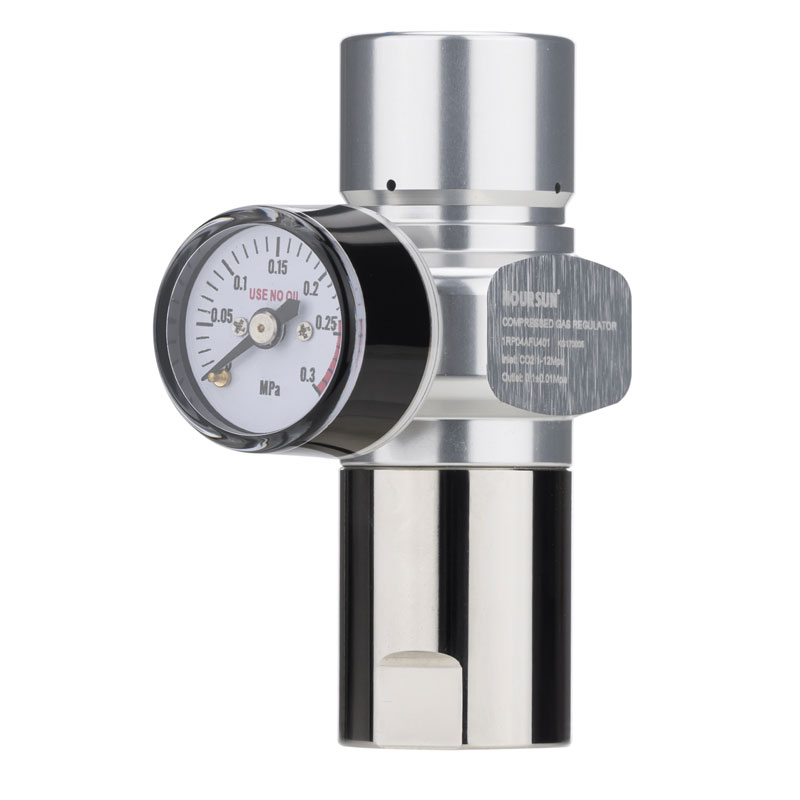 RP04-Dual Stage Argon Regulator CustomRP04-Dual Stage Argon RegulatorView Product →
Compressed air and paintball tanks
Gas
Common Connection
Full Cylinder Pressure
Typical Outlet Range
CO2
CGA 320 / W21.8
700 to 1,000 psi
0 to 60 psi
Argon
CGA 580 / W24.3
2,000 to 2,600 psi
0 to 50 psi
Nitrogen
CGA 580
2,000 to 3,000 psi
0 to 100 psi
Compressed air
CGA 346 / quick connect
up to 4,500 psi
400 to 850 psi
Specifications That Decide Whether the Regulator Works
Installation and Setup Checks That Prevent Most Problems
Failure Modes and What Actually Causes Them
Creep and a slow pressure rise
Freeze-up and icing around the body
Diaphragm rupture
Gauge failures
Leaks at the bonnet and fittings
A regulator that will not shut off
Application Playbook: The Same Hardware, Different Jobs
Soda water and beverage dispensing
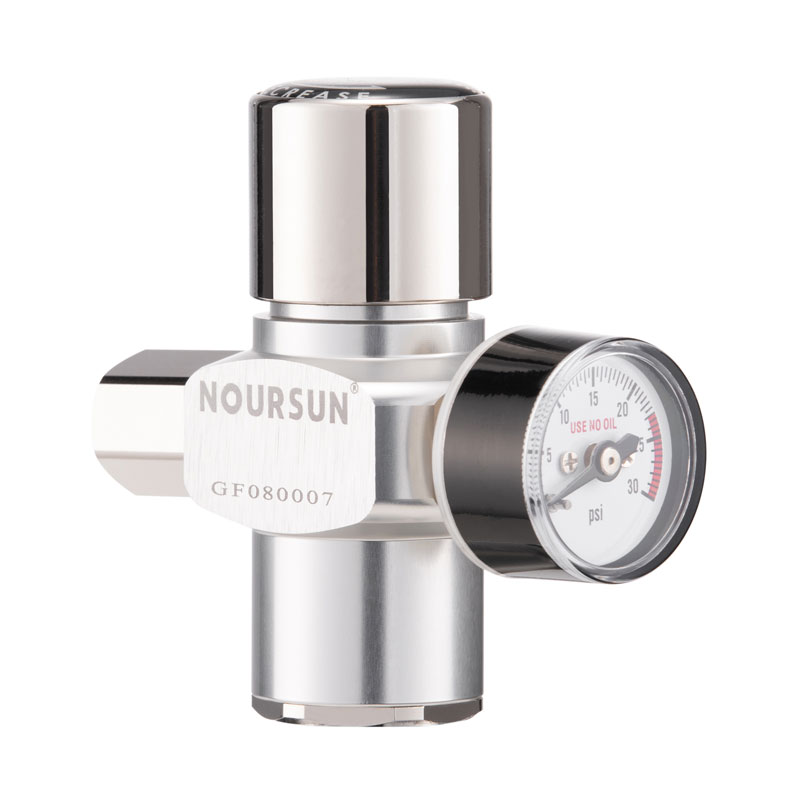 Custom Mini CO2 RegulatorRP02-Mini CO2 RegulatorView Product →
Beer dispensing
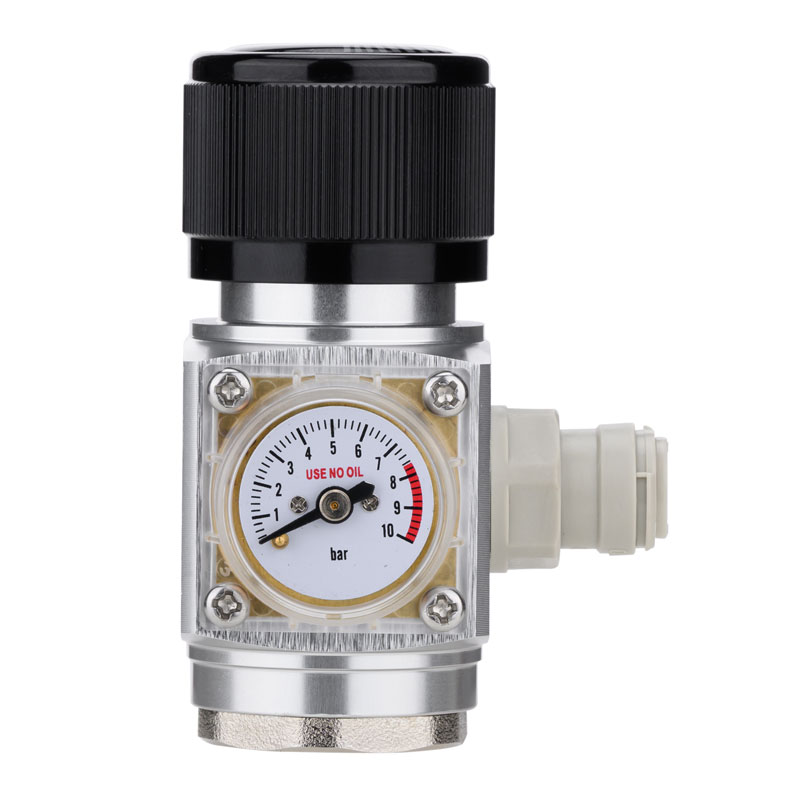 Beer CO2 Regulator FactoryRP20-Beer CO2 RegulatorView Product →
Hydroponics and aquarium CO2 dosing
Paintball and airsoft
Other gas control services
Sourcing Gas Cylinder Regulators: Questions Worth Asking
Frequently Asked Questions About Gas Cylinder Regulators
What is the difference between a regulator and a flow meter?
Can I use a CO2 regulator on argon or nitrogen?
What outlet pressure do I need for home soda water?
Why does my regulator pressure creep up overnight?
Do I need a check valve with a regulator?
What causes a regulator to freeze or frost over?
Single-stage or dual-stage for a kegerator?
Can a gas cylinder regulator be repaired?

Oct 26, 2026
A beverage equipment manufacturer in Europe was developing a countertop soda maker. The CO2 cartridge delivers gas at pressures from roughly 1,800 psi when full down to 150 psi when nearly empty, yet the carbonation chamber required a steady 65 psi. The first prototype used a pressure reducing valve, and outlet pressure drifted by nearly 20 psi as the cartridge depleted. The engineering team swapped in a gas pressure regulator, and the drift shrank to under 3 psi across the same inlet range. This real-world contrast answers a question that comes up constantly in gas and liquid systems: what is the actual difference between a pressure reducing valve and a pressure regulator, and which one should you specify? This article explains both devices, compares their operating behavior, and provides a practical selection framework. In simple terms, a pressure reducing valve limits downstream pressure by moving toward its closed position when outlet pressure rises above a set spring value. It does not actively compensate for changing inlet pressure or flow rate. A pressure regulator is a self-contained feedback device. An internal diaphragm senses outlet pressure, compares it against a spring setpoint, and continuously modulates the valve opening to hold that pressure at the target level. The direct conclusion: use a regulator when the medium is gas and outlet pressure must stay within a few percentage points of setpoint while inlet pressure or demand fluctuates. Use a pressure reducing valve when the medium is liquid, an accuracy band of plus or minus 10 percent is acceptable, and installed cost is a priority. A pressure reducing valve (PRV) is a mechanical valve that reduces a higher inlet pressure to a lower, preselected outlet pressure. Its main components are a valve body, a compression spring, and a diaphragm or piston. The spring pushes the valve toward the open position. Downstream pressure acts on the diaphragm in the opposite direction. When downstream pressure exceeds the spring setpoint, the diaphragm pushes the valve toward closed; when downstream pressure falls, the spring opens the valve wider. This is called direct-acting operation. PRVs are standard in municipal water supply, steam distribution, and hydraulic circuits. A typical residential example is the water pressure reducing valve installed where the public water main enters a house. Supply pressure from the main can be 60 to 80 psi, and the PRV is set to deliver around 50 psi to protect plumbing and appliances from excess pressure. Accuracy is the weak point of a PRV. A typical water PRV has a tolerance of plus or minus 10 percent or more. Set a valve at 50 psi and the actual outlet can be anywhere from 45 to 55 psi depending on inlet pressure and flow rate. For many liquid applications, that degree of variation is perfectly acceptable, which is why PRVs remain widely used in plumbing and hydraulic systems. A pressure regulator is a self-contained control device that maintains a nearly constant outlet pressure regardless of variations in inlet pressure or flow rate. Though it looks similar to a reducing valve on the outside, the internal geometry is different. A regulator includes a large-area diaphragm, a compression spring, and a valve seat. The diaphragm continuously senses outlet pressure. When outlet pressure drops slightly, the diaphragm moves and the seat opens further to admit more flow. When outlet pressure rises, the seat closes slightly. The result is a continuous feedback loop that holds pressure steady. This design gives a gas regulator a typical accuracy band of plus or minus 1 to 5 percent of setpoint across a wide inlet pressure range. For example, a single-stage regulator set to 30 psi on a CO2 tank will commonly hold outlet pressure between 29 and 31 psi as tank pressure falls from 800 psi to 200 psi. Regulators are the standard choice for gas systems: CO2 for beverage carbonation and beer dispensing, argon for welding and wine preservation, nitrogen for pressurization, and CO2 for aquarium and hydroponic plant growth. Because gases are compressible and flow demand varies widely, the feedback control of a regulator is essential for consistent output. The table above summarizes the core differences. The two most important points are medium and accuracy. If the medium is a gas, choose a regulator. If an accuracy window of plus or minus 10 percent is acceptable, a PRV will save cost and still function reliably. In a direct-acting PRV, the spring setting determines the pressure at which the valve starts to close. At zero flow, the valve is closed. As downstream flow is drawn, outlet pressure falls slightly, and the spring forces the valve open until flow balances. The valve only opens as much as needed. Because the spring compresses further as the valve opens, the force it exerts increases, and the outlet pressure falls as flow increases. This inherent spring effect is the source of droop. A regulator uses a large diaphragm that senses outlet pressure over a wide area. Even a small change in outlet pressure produces a measurable force on the diaphragm, which moves the valve seat to correct the flow. Because the diaphragm area is large in relation to the seat opening, the regulator amplifies small pressure errors into strong corrective actions. This amplification is what allows a regulator to hold pressure much tighter than a PRV. A single-stage regulator reduces cylinder pressure to outlet pressure in one step. When tank pressure is high and flow is low, the reduction ratio is large, and the regulator works harder. As tank pressure depletes, the outlet pressure shifts slightly. A dual-stage regulator solves this by splitting the pressure reduction into two steps. The first stage reduces tank pressure to an intermediate level, for example 200 psi. The second stage then regulates that constant intermediate pressure down to the final outlet pressure. Since the second stage always sees the same inlet pressure, its outlet remains exceptionally flat across the life of the cylinder. For applications that demand the flattest output, such as precision aquarium CO2 dosing or analytical instrumentation, a dual-stage design is the recommended approach. Droop, also known as offset or setpoint shift, is the difference between the setpoint at zero flow and the actual outlet pressure at rated flow. Every spring-based pressure device has some droop. What separates a regulator from a reducing valve is the amount. Measured on a flow bench, a simple PRV commonly droops 10 to 20 percent at rated flow. A single-stage gas regulator typically droops 3 to 10 percent. A dual-stage regulator holds droop to 2 to 5 percent across its recommended range. Response speed also matters. A PRV reacts to downstream pressure through its spring and diaphragm but has no amplification. When inlet pressure drops suddenly, the PRV opening may not adjust fast enough, causing a temporary outlet pressure dip. A regulator with a large diaphragm area reacts within milliseconds, and quality units do not oscillate or hunt when properly sized. Another issue that system designers run into is chattering. At low flow, a PRV may open and close repeatedly because the pressure sensing element lacks damping. Gas regulators avoid this by design, using the diaphragm area to create stable proportional control. When you need to verify performance on site, a dual-gauge design allows you to read inlet tank pressure and outlet delivery pressure simultaneously. This makes it easy to spot inlet pressure decline before it affects process quality. Use this step-by-step approach on any project to make the right decision the first time. The selection process is not complicated once you know the medium, the pressures, and the accuracy requirement. Most projects resolve to one clear answer after those three inputs are confirmed. CO2 regulators are the heart of carbonation equipment. A typical soda water system takes CO2 from a cylinder, reduces it from cylinder pressure to around 60 to 80 psi, and feeds the carbonation chamber. The output pressure directly affects how much CO2 dissolves into the water. Home users and commercial operators both need stable pressure to get repeatable carbonation. The RP07 soda water CO2 regulator from Noursun is configured for exactly this duty, with a compact form factor and consistent delivery across the cylinder life. Beer dispensing uses CO2, or a CO2-nitrogen blend, to push beer from keg to tap. Proper dispensing pressure must balance the carbonation level of the beer style. Too much pressure causes over-foaming; too little leads to flat beer. A stable regulator is non-negotiable in draft beer systems, and the same feedback principle applies across single-tap home kegerators and multi-tap commercial installations. Aquatic plants need CO2 at a precise injection rate. Regulators used with needle valves or solenoid valves in pH-control systems require minimal droop so that bubble counts stay consistent as the cylinder empties. Dual-stage designs are preferred for planted aquariums because they avoid the end-of-tank pressure drop that can crash pH levels in the water. Beyond food and beverage, gas pressure regulators appear in paintball tank filling, veterinary anesthesia machines, pest control equipment, and skincare carbonation devices. Each application imposes its own flow, pressure, and material requirements. Manufacturers like Noursun provide customization for OEM projects, from porting options to output pressure ranges, so the regulator integrates cleanly into the larger system. No. A PRV limits downstream pressure to a set maximum but does not actively correct for inlet pressure or flow changes. A regulator is a feedback device that continuously adjusts to hold outlet pressure steady. For gas applications, always choose a regulator. It depends on your accuracy requirement. CO2 systems that need repeatable carbonation, such as soda makers and aquariums, require the tighter accuracy of a regulator. A PRV will show noticeable drift as the cylinder pressure falls and would produce inconsistent carbonation. This is droop, caused by the spring compressing as the valve opens wider. All spring-loaded pressure control devices have droop. Dual-stage regulators minimize it by keeping the second stage inlet pressure constant. A single-stage regulator reduces cylinder pressure to outlet pressure in one step, so fluctuations in tank pressure pass through to the output. A dual-stage regulator adds an intermediate stage, which isolates the tank from the final output. Dual-stage units cost more but provide flatter pressure and less droop. Check your equipment required inlet pressure, then set the regulator at that level. Choose a model whose adjustable range brackets your pressure close to the middle of its spring range. Also confirm the device maximum inlet pressure is higher than your source pressure. For clean, dry gas service, quality regulators can run for years without maintenance. Check the inlet filter for debris periodically and verify the set output pressure with a reliable gauge. If outlet pressure drifts outside tolerance, the seat or diaphragm may need replacement. The difference between a pressure reducing valve and a pressure regulator comes down to control strategy. A PRV is a simple valve that limits pressure. A regulator is a feedback controller that maintains pressure. For liquids with loose accuracy needs, a PRV saves money. For gases, and for any process where outlet pressure stability affects product quality or safety, a regulator is the correct choice. Whether you are building a soda machine, a beer tap system, a hydroponic CO2 rig, or a custom OEM gas delivery module, specify the right pressure control component from the start. Browse the full range of Noursun pressure regulators or talk with the engineering team about your application requirements.Pressure Reducing Valve vs Regulator: The Short Answer
What Is a Pressure Reducing Valve?
What Is a Pressure Regulator?
Key Differences at a Glance
Comparison Aspect
Pressure Reducing Valve
Pressure Regulator
Primary medium
Liquid, steam
Gas (also some liquids)
Control mechanism
Direct-acting spring against downstream pressure
Diaphragm feedback loop with continuous modulation
Typical accuracy
Plus or minus 10% or wider
Plus or minus 1% to 5%
Droop at rated flow
10% to 20% or more
3% to 10% single stage; 2% to 5% dual stage
Response to inlet changes
Slow, visible output shift
Fast, minor output shift
Self-contained operation
Yes, but limited correction
Yes, full closed-loop control
Flow behavior
Suitable for steady flows
Suitable for variable flows
Typical applications
Water mains, steam lines, hydraulics
CO2, argon, nitrogen, gas appliances
Relative cost
Lower
Higher
Working Principle: Why They Behave Differently
Direct-Acting PRV Mechanics
The Regulator Feedback Loop
Single-Stage versus Dual-Stage Regulators
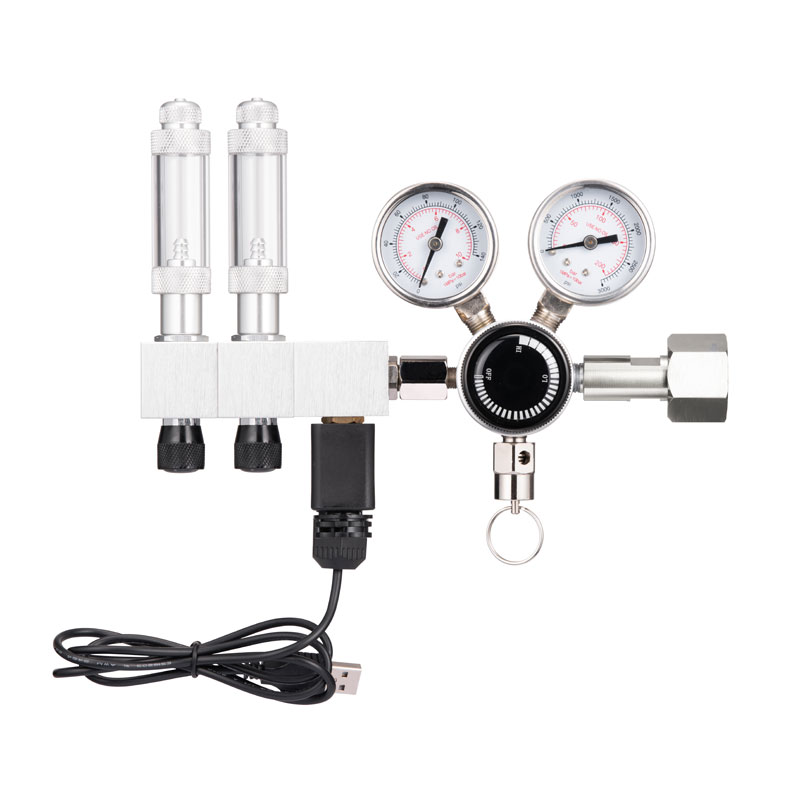 RP32-Dual Stage CO2 Regulator with Manometer CustomRP32-Dual Stage CO2 Regulator with ManometerView Product →
Accuracy, Droop, and Response Speed
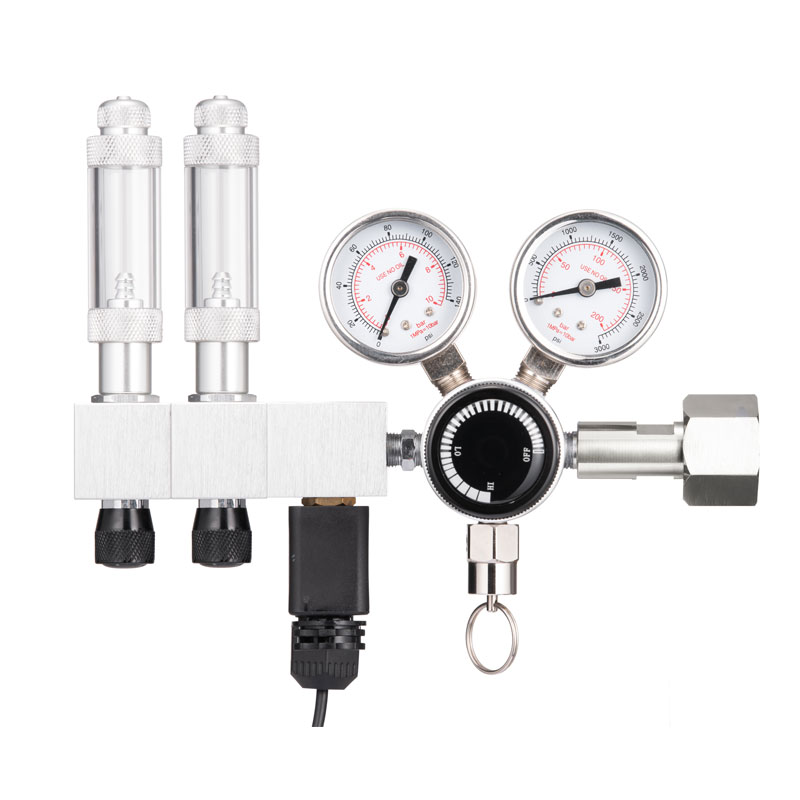 RP31-Dual Gauge Pressure Regulator CustomRP31-Dual Gauge Pressure RegulatorView Product →
How to Choose Between a Pressure Reducing Valve and a Regulator
Application Scenarios Across Industries
Beverage and Soda Water Systems
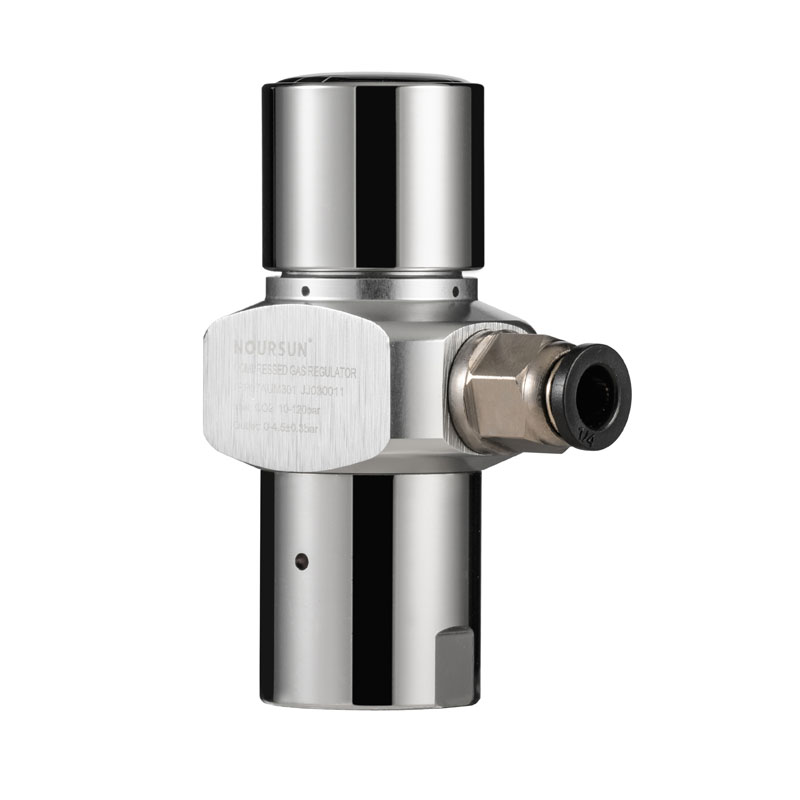 Soda Water CO2 Regulator CustomRP07-Soda Water CO2 RegulatorView Product →
Beer Dispensing
Aquariums and Hydroponics
Industrial and Custom OEM Equipment
Frequently Asked Questions
Is a pressure reducing valve the same as a pressure regulator?
Can I use a pressure reducing valve for CO2 gas?
Why does outlet pressure drop as flow increases?
What is the practical difference between single-stage and dual-stage regulators?
How do I determine the right outlet pressure setting?
How often do regulators need maintenance?
Final Thoughts

Oct 19, 2026
A pressure relief valve (PRV) is a mechanical safety device that automatically opens to release gas, vapor, or liquid from a pressurized system when the internal pressure exceeds a predetermined set point. It exists for one purpose: to protect vessels, pipes, pumps, and machinery from overpressure damage. The valve needs no electrical power, no controller, and no operator action. It responds purely to the pressure acting on its inlet, which is why engineers treat it as the last line of defense in a fluid circuit. During normal operation, the valve remains closed and passes no flow. It wakes up only in abnormal situations, such as a blocked discharge line, a failed pressure regulator dumping full cylinder pressure downstream, thermal expansion inside a closed vessel, or a sudden surge caused by equipment malfunction. When the pressure returns to a safe level, the valve reseats and the system continues running. That combination of inactivity in normal service and reliable action in an emergency is what makes a pressure relief valve different from a pressure regulator or a control valve. All spring-loaded pressure relief valves use the same balance of forces. An adjustable spring presses a disc or poppet against a ground seat, keeping the valve closed. The process fluid enters underneath the disc and pushes upward. As long as the downward spring force is greater than the upward pressure force, the valve stays shut. The set pressure is adjusted by compressing or releasing the spring, which changes the force required to lift the disc. When the inlet pressure reaches the set point, the upward force overcomes the spring, and the disc lifts. Because the fluid now acts on a larger projected area, the net opening force grows once the disc is off the seat. That geometric effect is responsible for the quick, decisive opening you want from a protection device. The flow continues until the pressure falls to the reseat level, at which point the spring pushes the disc back down and the valve closes again. Not every pressure relief valve opens in the same way. The medium, the pressure level, and the required flow all influence the design. The table below summarizes the most common configurations you will meet in commercial and industrial systems. Direct-acting valves are simple, inexpensive, and fast to respond. Because the spring force is fixed, the opening force becomes relatively smaller as the set pressure rises, so at high pressures they are more likely to chatter or need a larger body. Pilot-operated valves use a small pilot valve to control a larger main valve. They deliver higher flow capacity, narrower blowdown, and better stability at high pressures, but they cost more and require a relatively clean medium because the pilot sensing line can block with debris. When you compare pressure relief valves on a datasheet, certain parameters matter far more than brand reputation. Use the following checklist to understand what you are actually specifying. One common misconception is that two valves with the same connection size have the same capacity. In reality, the internal orifice diameter and the lift geometry determine the flow. Two valves with identical threads can pass very different flows, so always verify the Cv or the certified capacity rather than assuming the port size is enough. Pressure relief valves appear in almost every pressurized circuit, from small carbonation rigs to large hydraulic lines. A consolidated overview of documented use cases is available on the application page, but the examples below cover the environments where most engineers and technicians need them. A typical soda maker stores CO2 in a cylinder at pressures as high as 800-1000 psi (55-69 bar), while the regulator steps it down to about 30-60 psi (2-4 bar) for carbonation. If the regulator fails with the valve stuck open, the full cylinder pressure is directed toward the carbonating bottle, which is not rated for that load. A correctly set relief valve vents the excess gas and holds the bottle circuit at a safe level. This is the highest-volume application for small gas relief components in consumer appliances. In draft beer equipment, CO2 pushes beer from the keg through the lines to the tap at a serving pressure of about 12-15 psi (0.8-1.0 bar). A keg that warms up or a regulator that drifts upward can raise the pressure beyond what the coupler and tubing are designed to handle. A relief valve installed on the gas line or the keg coupler opens, vents the excess CO2, and prevents the keg liner from rupturing and the beer from becoming over-carbonated and foamy. Planted aquariums and small hydroponic setups dose CO2 through a diffuser to stimulate photosynthesis. Working pressure is usually modest, around 20-30 psi (1.4-2.0 bar), and the circuit contains a solenoid valve, a bubble counter, and a non-return valve. If the regulator drifts or the solenoid fails open, downstream pressure can climb unexpectedly. A compact relief valve placed between the regulator and the injection point is a low-cost insurance layer that keeps the diffuser and PVC lines safe. In hydraulic circuits, the relief valve is usually set slightly above the normal working pressure and acts as the system pressure limiter. When a cylinder reaches the end of its stroke, the pump continues pushing fluid into a locked volume. The relief valve opens and returns the fluid to the tank, preventing the pump from deadheading and the hoses from bursting. These valves are direct-acting in small circuits and pilot-operated where high flow must be bypassed smoothly. Air receivers, gas manifolds, and process vessels rely on pressure relief components as a final protection layer. A blocked liquid line that is heated, for example by sunshine or a steam jacket, can rise well beyond its design pressure without any inflow, simply through thermal expansion; a small thermal relief valve is the standard answer. Larger system reliefs are specified when a regulator creeps, a check valve traps a volume, or a process upset raises the pressure beyond the normal operating envelope. To select a pressure relief valve you need three numbers: the maximum allowable working pressure of the weakest component in the protected circuit, the maximum relieving flow the system can generate, and the operating temperature with the media composition. The steps below turn those numbers into a workable specification. A relief valve is only as trustworthy as the engineering behind its set point and capacity. At Noursun, pressure control is the core business: the company continuously designs and manufactures gas pressure regulators and associated trimming components for beverage, hydroponic, and industrial OEMs. The company profile explains that specialization and how it translates into predictable component reliability. A pressure relief valve that is never tested is just a plumbing fitting. In critical systems, it must be checked regularly to confirm that the set point has not drifted and the seat still seals. Here is a practical maintenance routine that fits most light industrial and commercial installations. Keep a simple log for each valve that records the set pressure, the test date, the cracking observation, and any replacement. That log becomes the evidence that your protection layer actually works, and it also catches slow degradation before it causes a failure. These are the questions we hear most often from engineers and maintenance staff when they start working with pressure relief valves. A relief valve is used with liquids and opens proportionally to the overpressure. A safety valve is used with gases, steam, or vapor and opens with a pop action once its set pressure is reached. The two names are often used interchangeably, but the opening behavior is technically different and each design matches its medium. A regulator maintains a constant downstream pressure during normal flow; it is a control component. A relief valve remains closed during normal operation and only opens when an abnormal high-pressure event occurs; it is a protection component. Installing a relief valve does not replace the need for a regulator, and vice versa. Cracking pressure is the inlet pressure at which the disc first lifts off the seat. It is the same as the set pressure in most valve specifications and is the value you adjust during commissioning. The cracking pressure must always be lower than the maximum allowable working pressure of the protected system. Chatter is the rapid open-and-close vibration that occurs when the valve cannot pass enough flow to sustain a lift, or when the set pressure is so close to the operating pressure that small disturbances repeatedly crack the valve. Oversizing and undersizing can both cause chattering. Correct sizing and a stable system pressure prevent it. For critical applications, test at least once per year. In continuous high-cycle services, inspect quarterly. In lower-risk consumer equipment, a visual and leak check every six months is reasonable. Regular testing is the only way to confirm that the set point has not drifted and the seat still holds. A single valve can protect a common manifold if the total relieving flow and the MAWP are known and compatible across every branch. In practice, each vessel and each branch line tends to have its own relief valve, because the worst-case flows and pressure ratings usually differ. Individual valves also make testing and isolation easier during maintenance.How a Pressure Relief Valve Works
Key operating terms
Types of Pressure Relief Valves
Type
Medium
Opening behavior
Typical use
Direct-acting spring-loaded
Gas or liquid
Opens gradually as pressure rises
Small systems, portable equipment, CO2 supplies
Pilot-operated
Gas, vapor, liquid
Pilot triggers a fully open main valve
High-flow, high-pressure installations
Safety valve
Gas, steam, vapor
Pops open rapidly
Boilers, air compressors, gas receivers
Relief valve
Liquid
Opens in proportion to overpressure
Hydraulic systems, liquid pumps
Safety relief valve
Gas or liquid
Pop on gas, proportional on liquid
Combined services
Thermal relief valve
Liquid
Cracks slightly with limited capacity
Blocked-in liquid lines, thermal expansion
Direct-acting versus pilot-operated valves
Key Specifications and Ratings
Parameter
Meaning
Why it matters
Set pressure range
The range over which cracking can be adjusted
Must cover your system maximum allowable working pressure with margin
Set pressure tolerance
How close the actual lift point is to the nameplate setting
A tight tolerance prevents late opening or premature nuisance trips
Blowdown
Drop from cracking to reseat as a percentage of set pressure
Controls how quickly the system recovers after a relief event
Flow coefficient (Cv)
Throughput at full lift under a stated pressure drop
Decides whether the valve can pass the worst-case flow
Temperature rating
Minimum and maximum service temperature for body and seals
Beyond the rated range, elastomers lose their sealing force
Wetted materials
Materials in contact with the process medium
Incompatible media cause corrosion, swelling, and sticking
Connection size
Inlet and outlet thread or flange dimensions
Must match your piping or manifold without reducing adapters
Where Pressure Relief Valves Are Used
Soda Water and Carbonated Beverage Systems
Soda Water CO2 Regulator with Relief Mechanism for Home CarbonationThis compact regulator precisely adjusts output pressure for consistent carbonation, while its relief valve protects the bottle circuit if the high-pressure cylinder fails, making it a key safety component in home soda systems.View Product →
Beer Dispensing Systems
Beer CO2 Regulator for Keg Dispensing with Stable Pressure ControlDesigned for draft beer systems, this regulator delivers steady serving pressure to keep pours consistent and prevent foamy or over-carbonated beer, offering a reliable safeguard against pressure spikes in keg lines.View Product →
Hydroponics and Aquarium Systems
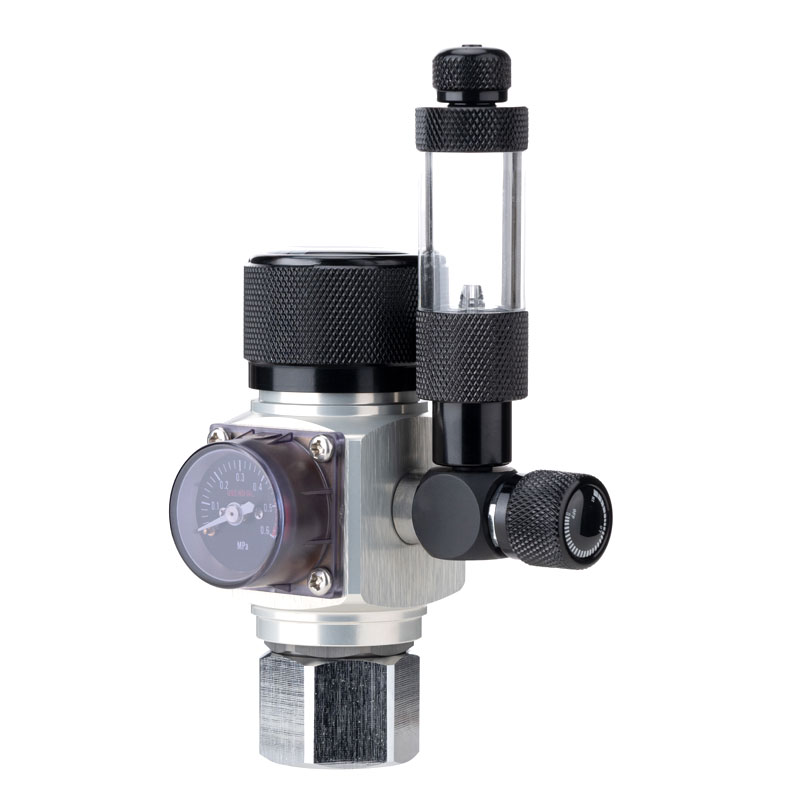 Compact Aquarium CO2 Regulator with Needle Valve and Bubble CounterThis compact regulator steps cylinder pressure down for planted aquariums, featuring a needle valve and bubble counter for precise, adjustable CO2 dosing—ideal for protecting diffusers and tubing when downstream pressure fluctuates.View Product →
Hydraulic Systems
Compressed Air and Industrial Gas Lines
How to Choose the Right Pressure Relief Valve
Step-by-step selection process
Mistakes to avoid
Maintenance and Testing
Frequently Asked Questions
What is the difference between a pressure relief valve and a safety valve?
What is the difference between a pressure relief valve and a pressure regulator?
What does cracking pressure mean?
Why does a pressure relief valve chatter?
How often should a pressure relief valve be tested?
Can one pressure relief valve protect the entire system?

Oct 12, 2026
Set a full CO2 cylinder on a scale and it will read somewhere around 6–7 kg. Inside, the gas is pushing at roughly 830 psi at room temperature. Now look at the plastic bottle in your soda maker. It is designed for about 80 psi maximum. If you connect those two things directly, something will eventually give. A regulator is the component that makes the connection safe, controlled, and repeatable. The short answer: a gas pressure regulator reduces high inlet pressure to a stable, adjustable outlet pressure, and it keeps that outlet pressure constant even as the cylinder empties or the gas flow changes. It is the only component between the gas source and your equipment that actually decides how much pressure your equipment sees. If you want one sentence to remember: a regulator turns "whatever is in the tank" into "exactly what your appliance needs." A pressure regulator performs three tasks at the same time, and every application depends on all three. To understand why these three tasks matter, look at the difference between the pressure in a gas source and the pressure your equipment actually needs. The easiest way to read a regulator is to think of it as a valve that opens when pressure falls and closes when pressure rises. Every regulator, regardless of size, uses the same balancing act between a spring and a gas-driven diaphragm. That balance is continuous, automatic, and entirely mechanical. The same principle applies to a tiny paintball regulator and a large industrial unit. The difference between a single-stage and a dual-stage regulator is a matter of how many reduction steps the gas passes through. A single-stage unit reduces cylinder pressure to outlet pressure in one step. A dual-stage unit does it twice: first from cylinder pressure to an intermediate pressure, then from that intermediate pressure to the final outlet pressure. Why does that matter in practice? In a single-stage regulator, the inlet pressure directly influences the internal balance. As the cylinder empties, its pressure drops, so the outlet pressure drifts slightly depending on the design. A dual-stage regulator isolates that effect, because the first stage always delivers the same intermediate pressure to the second stage, regardless of what the cylinder pressure is. For a home soda machine or a small planted aquarium, a single-stage regulator is usually enough. You will reset the outlet pressure occasionally at the start of each cylinder's life, and that is normal. For a draught beer wall where every keg should pour the same, or for any mixing operation where two gases must be blended consistently, a dual-stage regulator is worth the extra cost because it removes the variable that causes bad pours and inconsistent mixtures. Regulators appear wherever a gas cylinder meets a process. The fields that use pressure control most heavily are beverage, aquaculture, and high-pressure air. On Noursun's application overview, you can see regulators grouped by use case rather than by part number, which is the most practical way to understand what the device does in each setting. Home soda systems carbonate water by dissolving CO2 into cold water under pressure. The sweet spot is usually 40–60 psi, which produces the familiar 3–4 volumes of carbonation found in commercial sparkling water. At these pressures, a PET bottle reaches full carbonation in roughly two to three minutes with agitation. Regulators built for this job, like the RP07 soda water CO2 regulator, offer a clearly marked pressure range and a gauge so you can reproduce the same fizz every time. Draught beer systems balance CO2 pressure against temperature, line length, and beer style. In a typical kegerator running at 38°F (3.3°C), the serving pressure is between 10 and 15 psi. Push too hard, and you get foam and over-carbonated beer; push too gently, and the pour goes flat halfway through the glass. A beer-specific unit such as the RP20 beer CO2 regulator is designed to hold its setpoint within about ±1 psi, which is the tolerance that keeps a pint consistent from the first glass to the last. Planted aquariums and hydroponic grow areas use CO2 at very low pressures, usually 3–10 psi into a diffuser or reactor. At those levels, a small drift in pressure changes the bubble rate enough to stress the plants. Aquarium-specific regulators like the RP23 aquarium CO2 regulator provide a finer low-pressure adjustment than a beverage regulator, and many growers combine them with a solenoid valve on a timer so the CO2 stops at lights-off. Paintball fill stations use high-pressure air or nitrogen at up to 4,500 psi, and the regulator on the fill station steps that down to the tank's working pressure, typically 3,000–3,500 psi. That is a high-flow, high-pressure role rather than a precision low-pressure one. The same principle applies, but the materials, threads, and burst ratings are entirely different from a beverage regulator. A spec sheet can look intimidating, but four numbers tell you almost everything about whether a regulator fits your setup. At 50 psi, a 5 psi error is a 10% swing, which is enough to make a batch of sparkling water noticeably fizzier or flatter. At 10 psi, a 2 psi error is a 20% swing, which will push a draught line from a clean pour into a foamy mess. The lower your operating pressure, the more regulator accuracy matters. Most regulator problems are not mechanical failures. They are selection and setup mistakes made before the gas ever flows. A regulator is a precision component, but it asks for very little. Following a few habits will keep it accurate for years. Noursun's manufacturing process, described on their company background, includes testing each production batch for mechanical strength, durability, and safe operating limits, which is why a regulator from a dedicated manufacturer tends to hold its setpoint for much longer than an unbranded import. Some drop is normal, especially in single-stage units. As gas flows out of the low-pressure chamber, the diaphragm has to rebalance to feed more gas. This "droop" is around 3–8% in a well-designed single-stage regulator at maximum flow. If the drop exceeds 10%, you are probably exceeding the regulator's designed flow capacity and should move to a larger unit or a dual-stage design. A regulator controls pressure; a flow meter controls or measures volume per unit of time. An aquarium system often uses a regulator plus a needle valve, or a regulator with a built-in flow meter, because bubble rate is the variable you actually watch. The regulator keeps pressure constant, and the needle valve or flow meter decides how much gas escapes. Mechanically, many regulators thread onto both gas types, but you need a fitting that matches the cylinder and a pressure range suitable for the gas. CO2 cylinders hold roughly 830 psi when full, while argon cylinders can reach 2,000–3,000 psi. If the regulator's maximum inlet rating is lower than the cylinder pressure, it is unsafe regardless of whether the threads fit. The usual cause is a slow leak rather than a change in the regulator's setpoint. A tiny leak at a threaded joint gradually reduces the gas available and lets dissolved CO2 escape from the water. Close the cylinder valve after each session and test threaded joints with soapy water to confirm the system is sealed. The common warning signs are: the outlet pressure drifts even when the knob is untouched, the gauge shows pressure when the cylinder is closed, gas escapes from the body, or you hear a high-pitched whistle. If the unit cannot hold pressure with all downstream valves closed, the valve seat or diaphragm is worn and should be serviced or replaced. A cylinder-pressure gauge tells you how much gas remains; an outlet-pressure gauge tells you the pressure your equipment actually receives. For carbonated water and beer, the outlet gauge is essential. For aquarium CO2, you are already watching a bubble counter, so the cylinder gauge is the one you will rely on to avoid running the system dry.The Core Job of a Pressure Regulator
Gas source
Typical pressure at 20°C
Needed outlet pressure
CO2 cylinder, full
~830 psi
5–60 psi for most beverage and aquarium uses
CO2 cylinder, nearly empty
~350–500 psi
Same target, held by the regulator
Compressed air tank
up to 3,000 psi
80–120 psi for tools, lower for other uses
How a Regulator Actually Works
The three core parts
What happens while you are using it
Component
Role in pressure control
Adjusting knob
Changes spring tension to set the outlet pressure
Spring
Defines the target pressure level
Diaphragm
Senses outlet pressure and moves the valve seat
Valve seat
Opens and closes to allow or block gas flow
Low-pressure chamber
Holds a stable volume of outlet gas
Single-Stage vs Dual-Stage Regulators: Which One Do You Need?
Feature
Single-stage
Dual-stage
Reduction steps
1
2
Outlet pressure drift as the tank empties
5–15% typical
1–3% typical
Relative cost
Lower
Higher
Best suited for
Soda makers, basic CO2 aquarium setups, simple tools
Gas blending, argon shielding, keg systems, any process where constant pressure is critical
Gauge behaviour
Setpoint can creep as inlet pressure falls
Reading stays visibly flatter
What Do People Actually Use Regulators For?
Carbonating water at home
RP07 Soda Water CO2 Regulator with Adjustable Pressure GaugeThis regulator is highlighted for home carbonation systems, offering precise pressure control between 40–60 psi to achieve consistent sparkling water carbonation. Its built-in gauge and relief mechanism support repeatable results and safety.View Product →
Serving draught beer from a keg
RP20 Beer CO2 Regulator for Draft Dispensing SystemsPositioned after the soda regulator, this unit suits draught beer setups by maintaining serving pressure around 10–15 psi with ±1 psi accuracy. It helps prevent foam and flat pours, making it essential for consistent keg dispensing.View Product →
Injecting CO2 into an aquarium or hydroponic system
RP23 Compact Aquarium CO2 Regulator with Needle ValveThis regulator is ideal for planted tanks and hydroponics, providing fine low-pressure adjustment from 3–10 psi. Its needle valve and bubble counter enable precise bubble rates, with error within ±2 bubbles per minute for plant health.View Product →
Filling paintball tanks
How to Read a Regulator Specification Sheet
Specification
Why it matters
Typical value for home/light commercial use
Outlet pressure range
Must include your target pressure with margin
0–60 psi for beverage; 0–100 psi for multi-use
Max inlet pressure
Must exceed full cylinder pressure
3,000 psi for air; 1,500 psi or higher for CO2
Flow rate
Determines how fast gas reaches your equipment
100–500 L/min for beverage systems
Gauge accuracy
How trustworthy your pressure reading is
±1.5% of full scale
Why small pressure errors matter
Common Regulator Mistakes to Avoid
Safe Use and Basic Maintenance
Frequently Asked Questions About Gas Regulators
Why does my regulator pressure drop when gas flows?
What is the difference between a regulator and a flow meter?
Can one regulator handle both argon and CO2?
Why does my carbonated water taste different after a few weeks?
How do I know when my regulator needs replacing?
Is a cylinder gauge necessary?

Oct 05, 2026
A propane regulator is a mechanical pressure-reducing valve installed between the propane tank and the appliance. It takes the high, fluctuating pressure inside the tank — often 100 psi or more on a warm day — and drops it to a stable, low pressure that a burner can safely burn, normally about 11 inches of water column, which is roughly 0.4 psi. That pressure gap matters far more than most people realize. A typical 20 lb grill cylinder holds liquefied propane under vapor pressure, and that pressure moves up and down with temperature. At 70°F, you are looking at around 110 psi; at 110°F, the vapor pressure of propane climbs toward 196 psi, according to standard industry vapor-pressure tables. The appliance orifices are sized for a low, controlled inlet pressure. Unregulated gas at even a fraction of 100 psi would create violent flames, soot, wasted fuel, and a genuinely dangerous operating condition. This guide explains what a regulator does, how it operates step by step, the main types you will encounter when replacing or specifying one, the specifications that determine whether it fits your equipment, the failures you are most likely to see in service, and when your project should move from commodity hardware to a specialist pressure-regulator manufacturer. A propane regulator is a gas-flow control device that reduces storage pressure from the cylinder to the appliance working pressure, then holds that downstream pressure steady while the appliance draws varying amounts of gas. It is installed either directly on the tank valve or along the gas line between the tank and the equipment. Inside the housing sits a small but carefully balanced mechanical system. The exact design differs from one model to another, but these components are almost always present: The regulator is a purely mechanical device. There is no electronics inside, no motor, no sensor. It behaves like an automatic valve that adjusts itself continuously based on the pressure downstream. That is why a well-built regulator can run for years without attention while still delivering consistent performance. The numbers you see on the packaging — 11" WC, 10 psi, 30 psi — describe the outlet pressure that the spring is calibrated to hold. When someone says a regulator is set for a barbecue or set for low pressure, they are talking about that calibration. A regulator works by balancing two opposing forces: a spring pushing toward the open position, and gas pressure against the diaphragm pushing toward the closed position. When the two forces are equal, the valve stays in a fixed position and gas flows at a steady rate. Here is the sequence in practical terms: This open-close cycle repeats many times per second. During a normal cookout, the valve seat opens and closes continuously, letting only the exact amount of gas through that the burner demands. The result is a nearly constant outlet pressure from the moment you crack the tank valve until the moment you shut it off. With a single-stage regulator, the valve takes full tank pressure and drops it straight down to 11 inches of water column in one step. The trade-off is that no spring is perfect: as tank pressure changes with temperature and as the cylinder empties, the outlet pressure wanders slightly. Most grills tolerate this, which is why single-stage designs dominate outdoor cooking equipment. A two-stage setup splits the work. The first stage steps tank pressure down to around 10 psi. The second stage then reduces that 10 psi down to 11 inches of water column. Because the first stage isolates the second stage from tank-pressure swings, the final output remains exceptionally stable. This is why RVs, boats, and multi-appliance installations use two-stage regulators. Not all regulators are interchangeable. The correct type depends on the appliance, the gas flow rate, and whether the tank feeds a single device or an entire gas system. The table below summarizes the most common categories. The low-pressure single-stage regulator is the unit you see on most outdoor grills. It is compact, affordable, and matched to a specific flow range. The high-pressure regulator is a completely different product family: it is rated in psi rather than inches of water column and is designed for equipment that genuinely needs pressure, such as construction heaters and brazing torches. Two-stage regulators look like two bodies joined together and are normally sold with the first and second stage already matched. If you are wiring up a small camper or a backup household circuit, choose this type. Adjustable regulators are convenient during installation and testing, but once you set the outlet pressure, the adjustment should be secured so vibration cannot change the calibration. Before purchasing a propane regulator, compare these five values against your appliance manual. A regulator can be mechanically sound and still completely wrong for your application. Flow capacity deserves special attention. A typical gas grill draws 30,000 to 50,000 BTU/hr at full heat, while a 60,000 BTU shop heater draws more than that. Read the BTU rating stamped on the appliance and choose a regulator that exceeds it by at least 20%. When in doubt, a larger capacity is safer than a smaller one. Connection sizes are the other common source of frustration. The standard outdoor grill connection in North America is the QCC1/Type 1 fitting with a left-hand thread. RV and bulk-tank systems often use the POL fitting, and some appliance regulators accept 1/4 inch NPT. Measure the threads of the tank valve or hose before ordering, because returns and reordering are the most common cause of project delays. Under normal use, a propane regulator should last many years. But like any mechanical component, it can wear out, freeze, or simply be too small for the connected load. These are the failures you are most likely to encounter in the field: One rule applies across all of these situations: do not attempt to rebuild a regulator yourself. The calibration belongs to the manufacturer, and home repairs rarely hold. Replace the unit with a correct specification and verify that the outlet pressure matches the appliance requirement. For a single grill, replacing a regulator is a simple hardware decision. But for companies that design gas appliances, build beverage machines, or maintain fleet equipment, the regulator becomes an engineering specification. A poorly built regulator creates returns, warranty claims, inconsistent performance, and unhappy end users. This is where experience in pressure control matters. Noursun (Ningbo Noursun Industrial Co., Ltd.), a gas pressure regulator manufacturer established in 2012 in Ningbo, China, treats pressure regulation as its core business rather than a side product line. According to the company profile page, Noursun invests roughly 7% of annual revenue into research and development and holds more than 35 patents in gas pressure control technology. That background directly influences how consistently a regulator holds its calibration over thousands of open-close cycles. The interesting part is that the engineering transfers across gases. A propane regulator and a CO2 regulator are built around the same fundamentals: spring force, diaphragm travel, valve geometry, and tight tolerance on the seat. When you need stable pressure for carbonated beverage lines, aquarium CO2 dosing, or paintball tank filling, you are looking at the same physics with a different gas medium. For example, Noursun produces the RP20 Beer CO2 Regulator for beverage dispensing lines, holding downstream CO2 pressure steady through long pouring sessions so the beer maintains consistent carbonation. For soda and sparkling-water makers, the compact RP06 Sparkling Water Pressure Regulator is a single-stage unit designed for countertop carbonation machines. And for aquariums or hydroponic setups where fish and plants need predictable CO2 dosing around the clock, the RP32 Dual-Stage CO2 Regulator with Manometer removes the outlet-pressure drift you typically get from a single-stage unit. If you are an OEM, importer, or service business that needs consistent gas pressure control, it pays to discuss flow curves, port sizes, and body materials with an engineer before you commit to a part number. The Noursun engineering team can be reached through the contact page for custom pressure-regulator requirements and application-specific tuning. It reduces the high, variable pressure of propane vapor in the tank to a low, stable pressure that the appliance is designed for — normally around 11 inches of water column for household grills and heaters — and then modulates the flow as the appliance draws gas. Replace the regulator if you notice a persistent weak flame, yellow sooty flames, frosting on the body, a hissing leak at the vent, or a gradual loss of heat output that cleaning the burner does not fix. Any visible physical damage is also grounds for replacement. Rapid gas expansion cools the metal components, and moisture present in the gas line condenses and freezes on the surface. This is common on humid days or when a freshly filled tank introduces moisture. Keeping the vent clear and letting the unit warm up usually resolves it. Yes, if the regulator flow capacity exceeds the combined BTU load of all connected appliances. For multiple permanent appliances, use a two-stage regulator with a manifold so each branch receives stable pressure when other devices cycle on and off. They use different units and serve different purposes. One psi equals about 27.7 inches of water column, so 11 inches WC is roughly 0.4 psi. A 10 psi regulator therefore delivers about 25 times more outlet pressure and is intended for high-pressure equipment, not standard grills. No. Propane and CO2 have different vapor pressures, flow behaviors, and material compatibility requirements. Regulators are gas-specific for a reason, and swapping them introduces leakage and combustion risks. Always match the regulator to the gas that will actually flow through it. A quality regulator typically lasts 10 to 15 years indoors and fewer when exposed to harsh outdoor conditions. Inspect it annually, and replace it whenever the tank has been involved in a pressure-relief event, a severe drop, or visible corrosion.What Is a Propane Regulator?
How Does a Propane Regulator Work?
Single-Stage vs Two-Stage Regulation
Types of Propane Regulators
Regulator type
Output pressure
Typical use
Low-pressure single-stage
11 in WC (~0.4 psi)
Grills, patio heaters, fire pits, portable cookers
High-pressure regulator
1 to 60 psi
Propane torches, forced-air construction heaters
Two-stage regulator
First stage ~10 psi; second stage 11 in WC
RVs, trailers, cabins, multi-appliance systems
Integral appliance regulator
11 in WC
Built-in barbecue grills, commercial cooking ranges
Adjustable regulator
0 to 60 psi
Test rigs, custom manifolds, specialty equipment
Key Specifications to Check Before Buying
Specification
Typical range
Why it matters
Outlet pressure
11 in WC for consumer appliances; 1 to 60 psi for high-pressure gear
Wrong outlet pressure causes soot, weak flame, or a hazardous flare-up
Flow capacity
50,000 to 500,000 BTU/hr depending on size
An undersized regulator starves the appliance at high demand
Inlet connection
QCC1/Type 1, POL, or 1/4 inch NPT
Must match the tank valve or hose thread
Outlet connection
3/8 inch flare, 1/4 inch NPT, hose barb
Must match the appliance-side line
Operating temperature
-40°F to 140°F
Cold weather can cause icing and set-point drift
Common Propane Regulator Problems and Troubleshooting
When to Work With a Specialist Regulator Manufacturer
Noursun RP20 Beer CO2 Regulator for Draft DispensingThis beer CO2 regulator maintains steady downstream pressure during long pouring sessions, helping draft beer keep consistent carbonation and predictable foam.View Product →
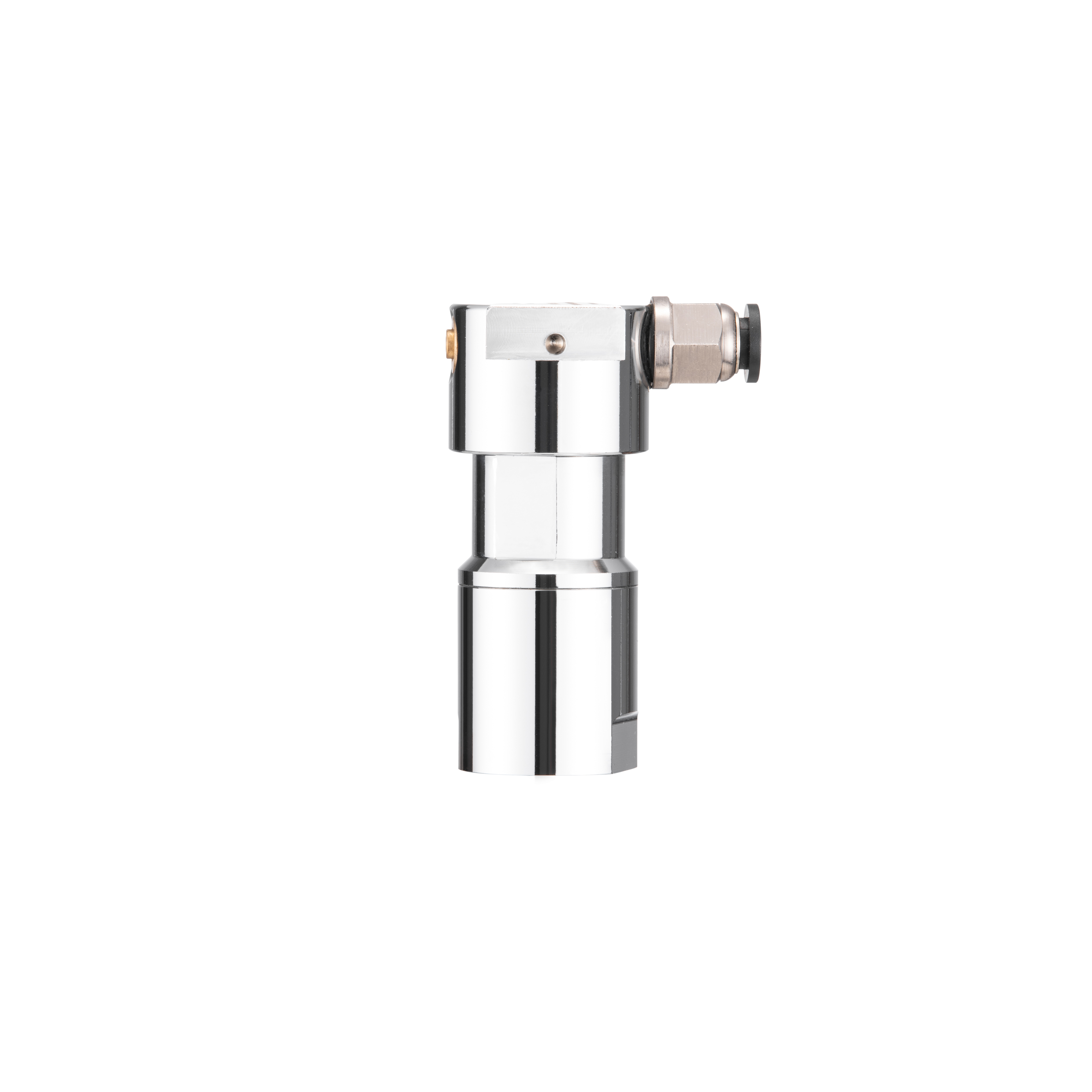 Noursun RP06 Sparkling Water Pressure RegulatorA compact single-stage regulator designed for countertop carbonation machines, featuring a top-outlet layout and built-in relief valve for safe, efficient sparkling water dispensing.View Product → Noursun RP32 Dual-Stage CO2 Regulator with ManometerA dual-stage regulator with manometer for aquarium and hydroponic CO2 dosing, featuring a solenoid valve, needle valve, and bubble counter to keep output stable within ±1 bubble per minute.View Product →
Frequently Asked Questions About Propane Regulators
What does a propane regulator do?
How do I know if my propane regulator needs replacing?
Why does my propane regulator freeze up?
Can I use one regulator for two or more appliances?
What is the difference between a 10 psi regulator and an 11 inch WC regulator?
Can I use a CO2 regulator on a propane tank?
How long should a propane regulator last?
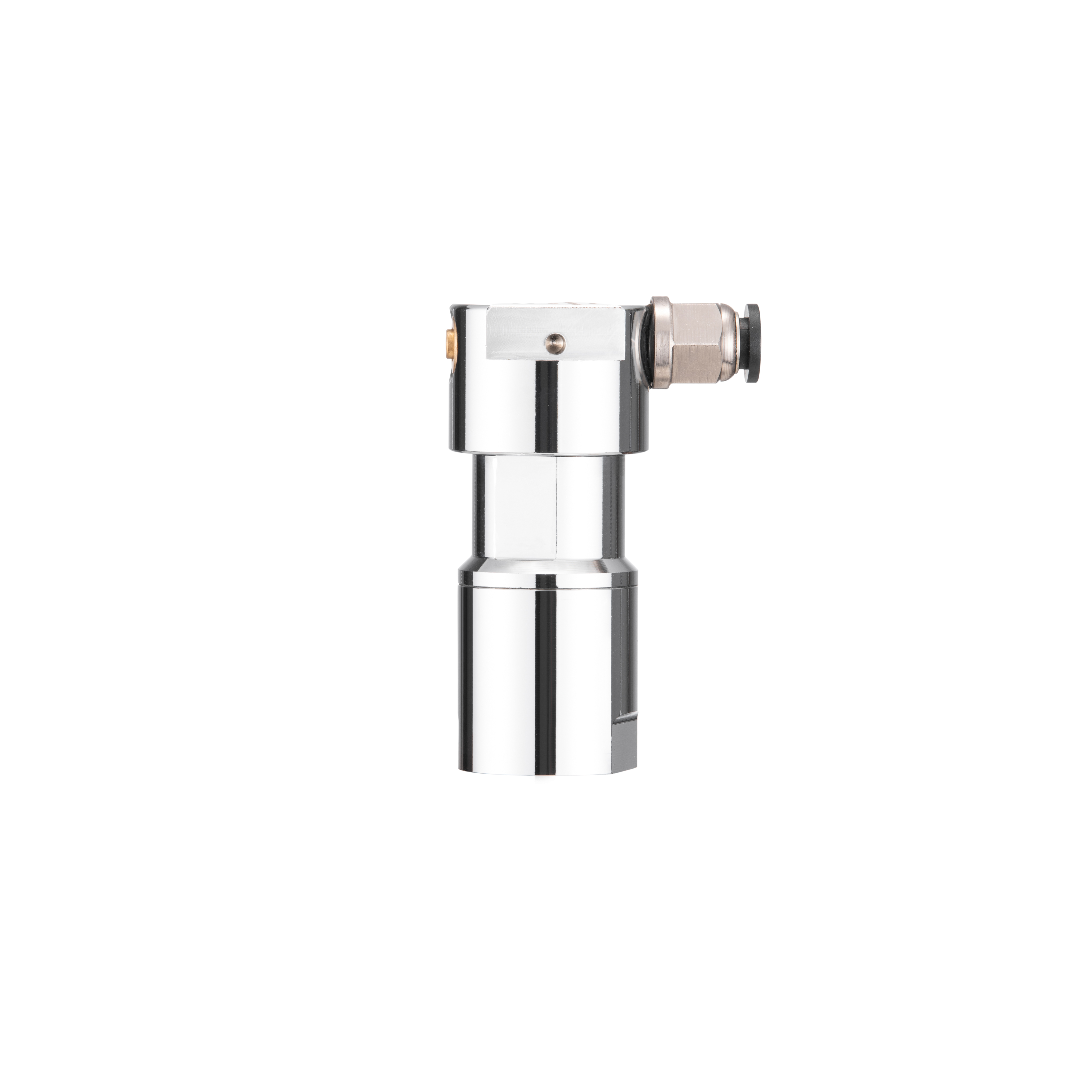
Sep 28, 2026
Your CO2 cylinder holds roughly 800 psi. Your soda machine needs a steady 75 psi to carbonate water consistently. The only component between those two numbers is a gas pressure regulator, and if its output drifts by even 5 psi, the carbonation level changes, the flavor becomes inconsistent, and customers notice immediately. The same pressure-stability principle applies to a beer kegerator at 12 psi, an aquarium CO2 injector at 30 psi, or a paintball gun at 800 psi. The direct answer to the most common buying question is this: choose a gas pressure regulator that delivers stable outlet pressure at your required flow rate, with seals compatible with your gas, and a stage design that matches your application's precision needs. Everything else is secondary. This guide walks through these decisions in depth. A gas pressure regulator is a mechanical device that reduces a high inlet pressure to a much lower, controlled outlet pressure. It does this continuously: as gas flows out, the regulator opens; as pressure builds, it closes. The core mechanism relies on a spring-loaded diaphragm that balances downstream pressure against spring force. Here is the typical sequence inside a single-stage regulator: The most common gas used in consumer and light industrial regulators is carbon dioxide (CO2), which is stored as a liquid in cylinders. At room temperature, a partially filled CO2 cylinder holds a vapor pressure of approximately 800 to 1100 psi. The regulator must safely reduce this to something usable, typically 12 to 100 psi depending on the application. The regulator is the first point of contact between the gas source and your equipment, so by the time gas reaches the final device, the pressure must already match the specification. That is why regulator quality has a direct and measurable impact on product consistency. Buying a gas pressure regulator without checking the key specifications is like buying a pump without knowing the flow rate you need. These are the parameters that define whether a regulator will work in your system: Beyond pressure and flow, check these details: This is one of the most common questions from customers. A single-stage regulator performs one pressure reduction step. It is simpler, smaller, and more affordable. However, its outlet pressure will change as the cylinder pressure changes. As a CO2 cylinder empties, its vapor pressure gradually falls, causing the regulator to slightly reduce its output. The amount of drift depends on the design, but it can be as much as 5 to 15 psi in a typical single-stage unit. A dual-stage regulator reduces pressure in two steps. The first stage drops cylinder pressure down to an intermediate pressure, and the second stage brings it to the final delivery pressure. Because the second stage sees a relatively constant inlet pressure, the output stays remarkably stable. Dual-stage regulators are the preferred choice for applications where pressure fluctuation directly affects product quality, such as: A good rule of thumb: if your outlet pressure is below 50 psi and you are using the regulator until the cylinder is nearly empty, a dual-stage regulator will pay for itself in consistent output and fewer adjustments. For rough-duty applications like paintball or welding where pressure can vary within a wider window, a single-stage regulator is simpler and more cost-effective. The key difference is not better or worse, but which one fits the precision budget of your process. Each gas-driven system has a unique pressure and flow profile. Here is a practical breakdown of the main application categories and the regulator features that matter most for each. For soda water and sparkling water carbonation, the target is consistent gas dosing into chilled water at around 60-100 psi. The regulator must hold that pressure even as the machine cycles on and off. A dual-gauge design helps because you can instantly see whether the output pressure is drifting. The outlet pressure directly determines the volume of CO2 dissolved in the water, so a regulator that holds 75 psi within a tolerance band of plus or minus 2 psi will produce a much more consistent mouthfeel than one that allows drift to 85 psi. For beer dispensing, outlet pressure is much lower, typically 12-30 psi, and the flow rate is modest. Here the key concern is pressure creep. If the regulator creeps upward, the beer will over-carbonate and pour with too much foam. A regulator that includes a check valve downstream prevents beverage backflow from damaging the adjustment spring. For aquarium and hydroponic CO2 dosing, the bubble rate is the only control variable. A dual-stage regulator with a fine adjustment knob and a bubble counter connection is the right tool. The flow rate is tiny, in the range of 30 to 60 bubbles per minute, so the regulator must be very sensitive and smooth in its response. For industrial and commercial systems, the decision is often about flow capacity. Larger systems may need a regulator that can pass more gas per minute. Our engineering data shows that selecting a regulator with 25 to 30 percent more flow capacity than your peak demand avoids pressure sag during high-demand events. Once you know your application, the process of choosing becomes straightforward: decide on outlet pressure, determine peak flow, select stage design, and verify the inlet connection. If you need more help, Noursun provides application-specific guidance and engineering support for OEM projects. Even the highest quality gas pressure regulator will fail prematurely if installed or maintained incorrectly. These practices, drawn from field observations across beverage and hydroponic systems, will help you get the most out of your regulator. Cleaning is straightforward: use only mild soapy water. Never use alcohol-based solvents on the regulator body, as they can degrade the rubber seals. After cleaning, allow the unit to dry completely before reconnecting it to the gas line. Also, when storing spare regulators, keep them in a dry, cool place below 30 degrees Celsius because heat accelerates seal aging. The same regulator can behave differently in a cool basement near a beer keg and in a warm shipping container on its way to a distributor. Understanding the environmental variables helps you build a more reliable system. Temperature is the biggest factor. CO2 cylinder pressure rises with temperature. A cylinder at 20 degrees Celsius shows about 830 psi, while the same cylinder at 30 degrees Celsius rises to about 950 psi. This means the regulator's first stage in a dual-stage design has to handle an inlet swing of over 120 psi across a 10 degree temperature change. In hot environments, the regulator body itself can heat up, which changes the spring force slightly and causes a small output pressure shift. That is why temperature-compensated design matters in high-flow systems. Humidity is a second factor, especially for regulators installed in outdoor or semi-outdoor units. Condensation can enter the bonnet through the adjustment screw thread, causing corrosion of the spring and eventual seizing. Applying food-grade grease to the adjustment thread is a common preventive measure used in commercial beverage installations. Dust and particulates are the third factor. In paintball fields, for example, dust can settle on the valve seat after repeated pressure cycling. A disposable inlet filter is a cheap and effective insurance policy. In our experience, more than 40 percent of field returns come from contamination-related seat issues rather than manufacturing defects. Most regulator issues in the field fall into a few predictable categories. Knowing what they look like before they happen saves hours of troubleshooting. A simple test that most users forget: after closing the supply valve, record the delivery pressure on the gauge, then wait 10 minutes. If the pressure has increased, the valve seat is not sealing. If it has dropped, something downstream is leaking. No. CO2 regulators are designed for CO2's specific pressure ranges and seal materials. Using a CO2 regulator with air or nitrogen can lead to leaks and pressure instability because the seals are not optimized for those gases. Choose a regulator specifically rated for the gas you are using. Open the cylinder valve slowly, then rotate the adjustment screw clockwise to increase pressure. Set the desired pressure while gas is flowing, not while the line is sealed. If a system uses a solenoid or intermittent flow, the pressure should be set at the moment of flow, because the regulator output naturally rises when flow stops. Size is determined by peak flow demand. As a general rule, select a regulator that can deliver 25 to 30 percent more flow than your system needs in its highest demand state. Undersizing causes pressure sag and inconsistent performance. Oversizing by a large margin can create oscillation. Not recommended. Beer systems operate in the 12-30 psi range, while soda systems run at 60-100 psi. Using a soda regulator for beer will over-carbonate the beer and create excessive foam. Using a beer regulator for soda will not deliver enough pressure to carbonate water properly. Freezing occurs when CO2 expands rapidly at the valve seat, absorbing heat. This happens when the flow rate is too high for the regulator's capacity. Move the regulator closer to the point of use, use a larger regulator, or choose a regulator designed for high-flow applications with internal heating features. In moderate-use environments, inspect the diaphragm and seals every 12 months. In heavy-duty or high-duty-cycle applications, replace the diaphragm every 6 months. The adjustment spring can last much longer, but it should be checked for corrosion if the regulator shows signs of moisture exposure. For more information about a manufacturer's quality control approach, see Noursun's quality control process.What Is a Gas Pressure Regulator and How Does It Work?
Critical Specifications to Check Before You Buy
Application
Typical Outlet Pressure
Typical Flow Rate
Regulator Type
Soda water carbonation
60-100 psi
0.5-2 l/min
Single-stage or dual-stage
Beer dispensing
12-30 psi
1-3 l/min
Single-stage or dual-stage
Aquarium CO2 dosing
20-45 psi
0.1-0.5 l/min
Dual-stage with gauge
Paintball air systems
650-850 psi
5-15 l/min
Fixed high-pressure
Single-Stage vs Dual-Stage: Which One Do You Need?
Dual Stage CO2 Regulator with Manometer for Aquarium and Precision ApplicationsThis dual-stage regulator delivers stable output across the full cylinder life, with dual gauges for tank and line pressure. Ideal for aquariums, grow rooms, or greenhouses where consistent CO2 dosing is critical.View Product →
How to Match a Regulator to Your Application
Soda Water CO2 Regulator with Overflow Protection for Carbonation SystemsDesigned for household or commercial carbonation, this regulator lets you fine-tune output pressure for consistent fizz. Its sealing-before-opening mechanism maximizes gas use and safety.View Product →
Beer CO2 Regulator with Leak-Proof Design for Draft DispensingBuilt for beverage distribution, this compact regulator holds steady low pressure to prevent over-carbonation and foamy pours. Its leak-proof technology ensures safe, efficient gas use.View Product →
Installation and Maintenance Practices That Extend Regulator Life
Environmental Factors That Affect Gas Pressure Regulator Performance
Common Operational Problems and How to Solve Them
Problem
Typical Cause
Recommended Fix
Outlet pressure rises over time
Foreign debris lodged inside the valve seat
Disassemble, clean, and inspect the seat surface
Outer body forms ice or frost
Excessive pressure drop or high flow rate
Move regulator closer to the device or upgrade flow capacity
Bubble rate fluctuates in aquarium
Single-stage design on a nearly empty cylinder
Switch to a dual-stage regulator
Leaking gas from bonnet
Diaphragm split or seal flattened
Replace diaphragm and seal
Frequently Asked Questions
Q1. Can a CO2 regulator be used for air or nitrogen?
Q2. How do I set the outlet pressure correctly?
Q3. What regulator size do I need?
Q4. Can I use the same regulator for a beer kegerator and a soda machine?
Q5. Why does my regulator freeze and stop working?
Q6. How often should a regulator be serviced?
ADD: No. 50, Zhongxing East Road, Xikou Town, Fenghua District, Ningbo City, Zhejiang Province, P.R. China
0086-574-88881358
0086-574-88473625
About Us
Industry Applications
News & Events
